

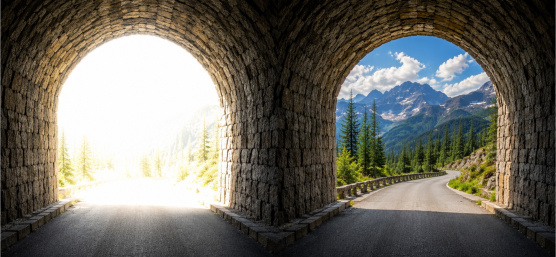
HDR industrial cameras for high-contrast scenes
Abstract
HDR industrial cameras capture details in very bright and very dark areas of an image within a high-contrast scene. Depending on the application, Clear HDR, Quad HDR, or Sequence HDR may be used. The IDS peak software supports the evaluation, processing, and integration of these technologies through a unified software workflow.
High dynamic range, more details
Highly reflective surfaces, changing lighting conditions, or large differences in brightness can obscure important image information. HDR expands the usable dynamic range and reveals details that might be lost in overexposed or underexposed areas in a conventional image.
What is High Dynamic Range (HDR) in industrial cameras?
Dynamic range describes the brightness range that an image sensor can capture, from the darkest signal that is still discernible to the brightest image information that can still be recorded. If the contrast of a scene exceeds this range, information is lost: bright areas appear saturated, whilst details in dark areas may be lost in image noise.
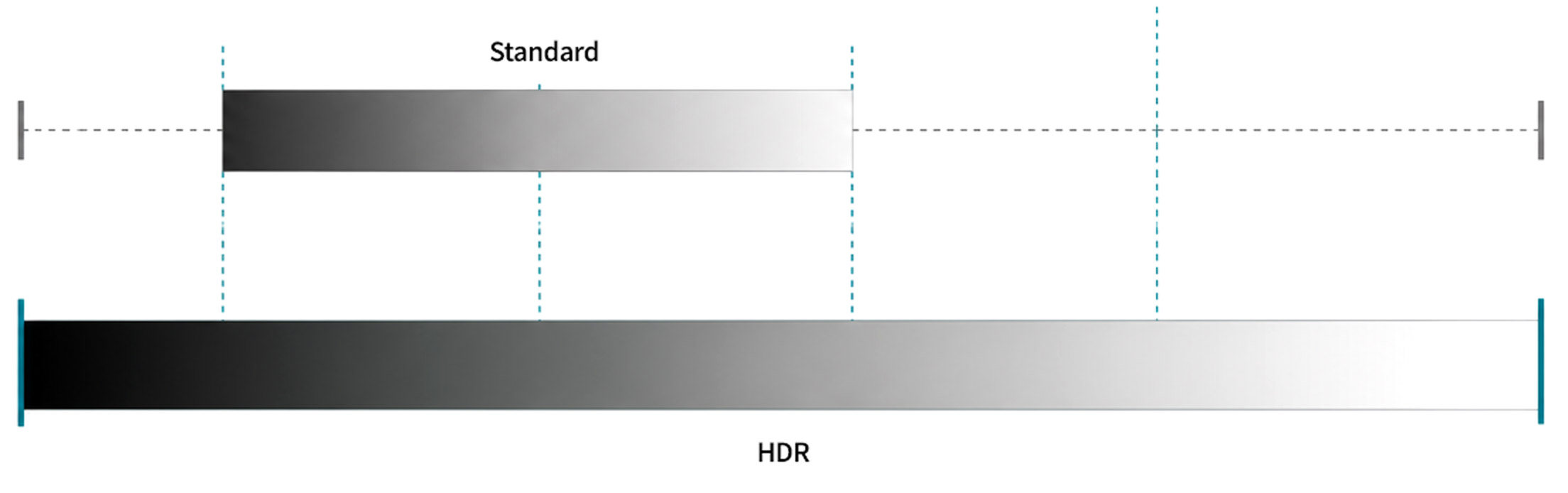
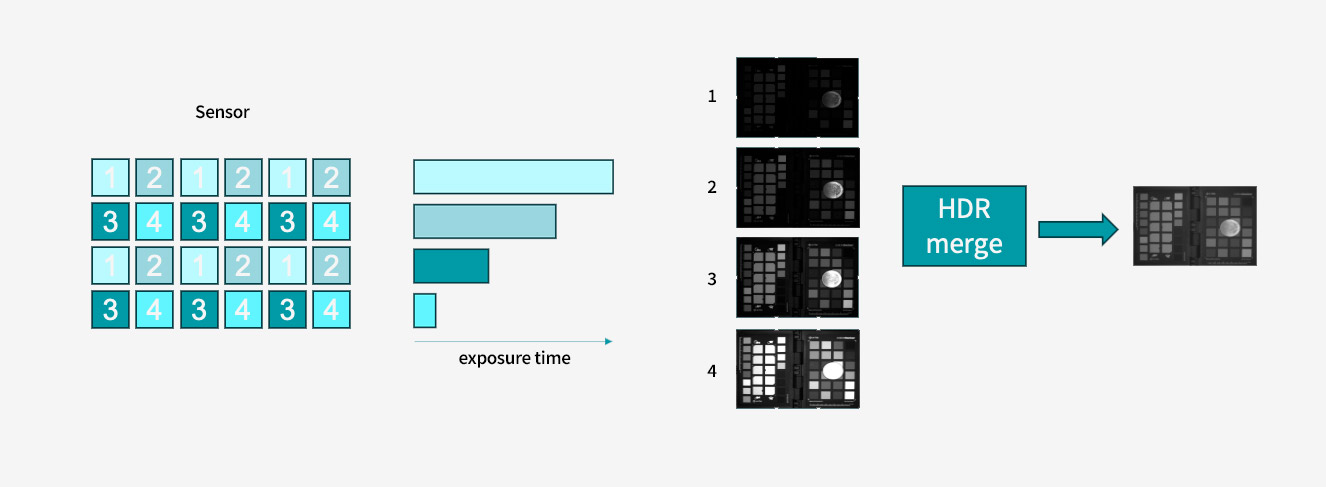
HDR expands this usable range. Depending on the technique used, image information is captured with different amplification levels or exposure times and combined to produce an image with a higher dynamic range.
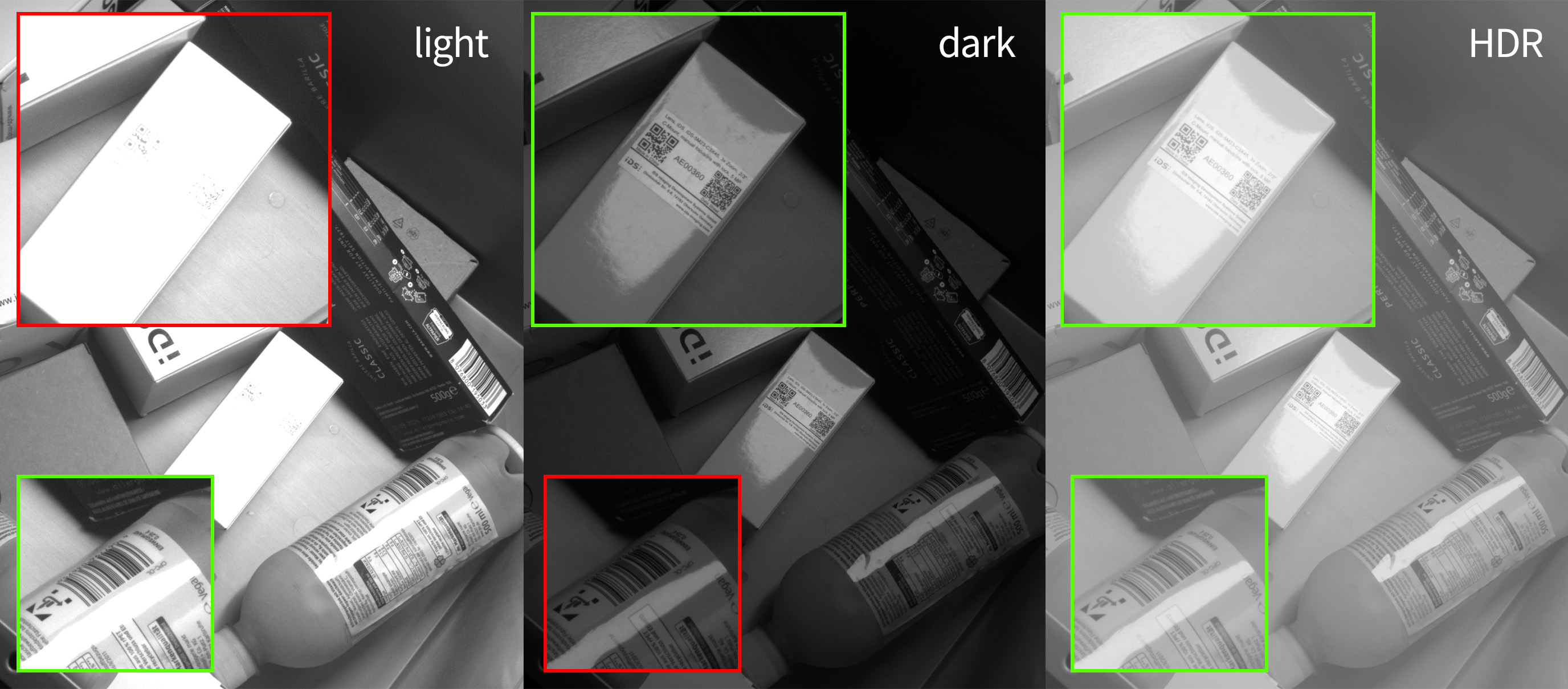
Advantages of HDR
- Capture more detail: Structures in both dark and light areas of an image can be captured and analyzed simultaneously.
- Greater robustness: More robust image data, even in the presence of reflections, shadows and bright light sources in the field of view.
- More reliable data: A better information base for inspection, identification, process monitoring and automated decision-making.
Use HDR easily with IDS instead of implementing it yourself
HDR is more than just a feature of the image sensor. It is only the combination of a suitable camera, appropriate data acquisition, image stitching and output that the enhanced image information becomes practically usable.
IDS supports various HDR technologies through a unified software approach. With IDS peak, users can configure HDR-capable cameras, capture raw data and process or visualize HDR results. This reduces the need for in-house developments specific to individual camera models and makes it easier to evaluate different solutions.
IDS advantages
- Multiple HDR modes: Clear HDR, Quad HDR and Sequence HDR cater to different requirements in terms of movement, resolution and dynamic range.
- Comprehensive support in IDS peak: Capture, merging and tone mapping are integrated into the IDS peak SDK. Users can access individual HDR exposures as well as calculated HDR and LDR results.
- Evaluation without the need for custom programming: HDR results can be tested and visualized in the IDS peak Cockpit. Source code samples then facilitate integration into the user’s own application.
- Suitable image data for different workflows: Depending on the application, users can work with raw data, HDR data or an image prepared for standard displays.
Three HDR modes for different requirements
Clear HDR
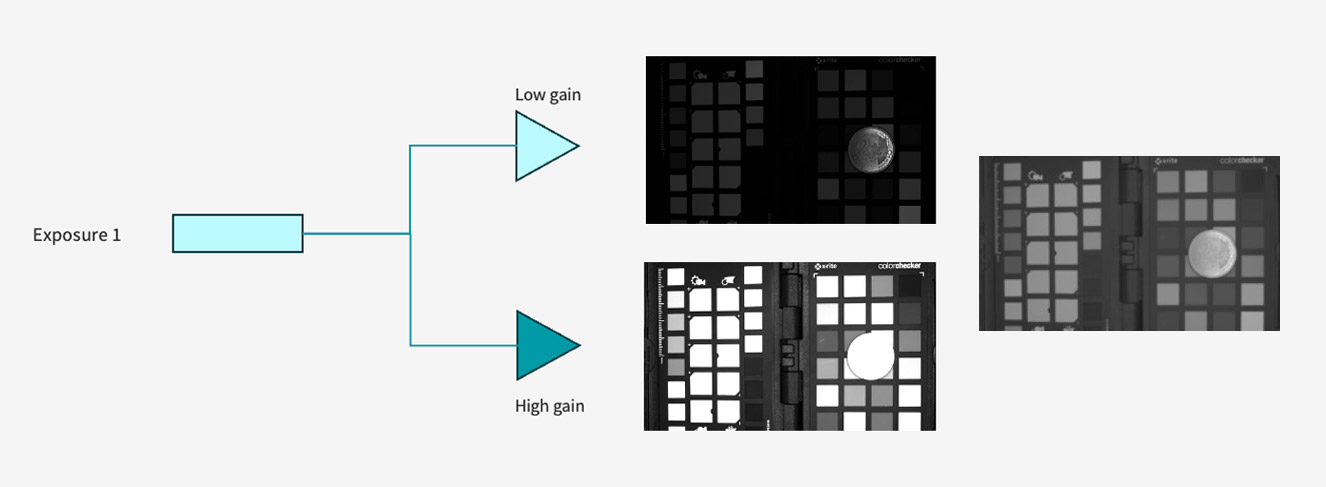
Greater dynamic range from a single exposure
Clear HDR reads the image data from a pixel across two gain levels. This allows dark areas to be captured with greater sensitivity and bright areas to be rendered with a higher saturation reserve. The full spatial sensor resolution is retained.
Quad HDR
Multiple exposure settings within a single frame
Quad HDR uses groups of pixels with different exposure times, for example in the Sony IMX900. This provides several brightness values within a single frame. In conjunction with the global shutter sensor, this technique is particularly well-suited to dynamic scenes.
Sequence HDR
Flexible exposure sequences for maximum image detail
With Sequence HDR, the industrial camera captures several images with different exposure times and combines them to produce an HDR image. The number and gradation of the exposures can be adjusted to suit the required dynamic range and the desired image quality. This mode is available for virtually all IDS industrial cameras.

Mode |
Particularly useful for |
Notes |
See cameras |
|---|---|---|---|
Clear HDR |
Scenes with movement or slight movement, where resolution and color accuracy are important. |
The additional readout increases the data volume and may reduce the maximum available frame rate. |
|
Quad HDR |
Moving objects, quick processes and applications where high dynamic range is more important than maximum spatial detail resolution. |
The different exposure data is distributed across pixels within a 2x2 block. This reduces the effectively usable spatial resolution. |
|
Sequence HDR |
Static or slowly changing scenes, where high resolution and a flexibly adjustable dynamic range are required. |
As several images are captured in succession, movement and the number of exposures can affect the usable frame rate and the final result. |
In these applications, HDR makes the difference
Quality assurance for reflective components
Metal surfaces, electronic components, solder joints, shiny casings or painted bodywork parts can exhibit both strong reflections and dark textures at the same time. HDR helps to make more of this information usable in a single image or sequence of images.
Logistics, OCR and barcode scanning
Glossy labels, foils, varying packaging materials and different orientations can cause localized reflections. HDR industrial cameras can help ensure that barcode, Data Matrix and text information remains readable under varying contrast conditions.
Medical technology and microscopy
Reflective materials and transparent structures can produce very different levels of intensity within a single image. For largely static samples, Sequence HDR can be particularly useful when resolution and a wide detectable brightness range are the main priorities.
Welding and process monitoring
Arcs, embers, sparks and dark areas of the workpiece create extreme differences in brightness. A motion-tolerant HDR method can provide more usable image information for process monitoring or downstream analysis.
Robotics and automation
Changing positions, varying surfaces and lighting conditions that cannot be fully controlled can make image capture difficult. HDR industrial cameras expand the scope for robust image data in detection, positioning and handling.
Transport and outdoor applications
Daylight, shadows, headlights, tunnels or changing weather conditions can create significant differences in brightness within a single scene. HDR is particularly relevant here for environmental detection and number plate recognition.
Evaluating and integrating HDR with IDS peak
The IDS peak software supports the entire workflow, from HDR capture through to further processing. In the IDS peak Cockpit, you can initially evaluate HDR functions and results without needing your own application. API functions, documentation and programming examples are available for integration.
Further information

Since 2011, Oliver Senghaas has served as Head of Marketing at IDS, driving the company’s global marketing strategy. He is responsible for corporate communications, brand management, digital campaigns, the content and functional development of the company websites and B2B web store, as well as the creation of technical documentation. His focus is on combining technology and creativity to position IDS clearly in the field of industrial image processing.
Vision Channel
Videos and live sessions about machine vision.
Your project
How can we support you in your project? Together we will find the right solution for you!
Newsletter
Stay up to date and subscribe to our newsletter.