

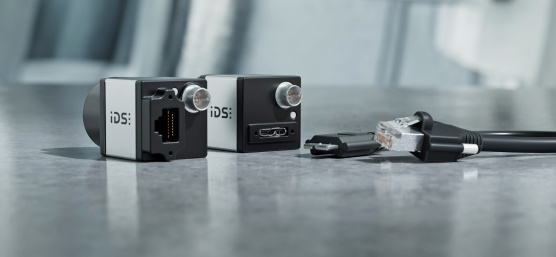
USB 3 or GigE: Which interface is right for my application?
Abstract
USB 3 offers high data transfer speed and is particularly suitable for short distances and high data rate applications.
GigE enables long cable lengths, integration of multiple cameras and high system flexibility.
Choosing the right interface depends on cable length, data rate and system architecture.
This article compares USB3 Vision with GigE Vision over standard Gigabit Ethernet. Higher Ethernet speeds and GigE Vision 3.0 are mentioned only as a preview.
Two standards, two philosophies
USB 3 and GigE – with the established USB3 Vision and GigE Vision standards – are among the most important interfaces in industrial machine vision. Both enable communication between industrial camera and computer. Depending on the application, they offer specific advantages. The differences are mainly in the areas of bandwidth, cable length, flexibility and integration effort.
USB3 Vision and GigE Vision are cross-manufacturer standards set by (Association for Advancing Automation). They define not only the physical interface, but also a uniform communication and configuration model based on GenICam. The aim is to ensure interoperability, investment security and broad software support. The use of standardized vision interfaces brings advantages: cross-manufacturer compatibility, uniform configuration via GenICam, broad software support and long-term investment security. At the same time, standardization also entails a certain amount of overhead. In practice, however, cross-manufacturer interchangeability depends on the consistent use of standardized functions. If additional manufacturer-specific functions are integrated and used by users, software adjustments may be required should the camera be replaced at a later date.
Despite the similarities, both interfaces differ fundamentally in their approach:
USB 3 for maximum performance at short distances, easy handling
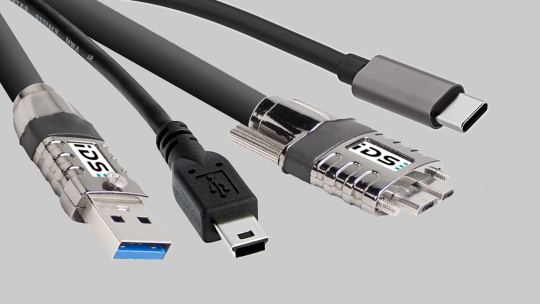
USB3 Vision is a standardized interface protocol for industrial cameras based on USB 3.x. The standard has been specially developed for industrial image processing and enables fast and reliable data transmission between camera and computer.
The interface offers a high net data rate of up to 400 MB/s. The camera can be powered and data transmitted via the same cable, meaning no additional cabling is required.
USB3 Vision is preferably used in compact systems with short distances, high data rate and easy integration. Typical applications are single-user and embedded systems, laboratory environments and compact testing stations. The maximum cable length is 3 to 5 meters, or up to 50 meters with active fiberglass cables.
GigE for networked, scalable camera systems and range
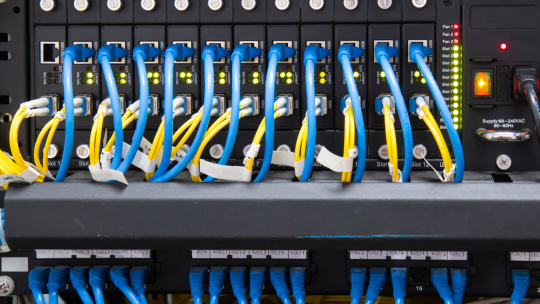
GigE Vision is an industry standard for image transmission over ethernet networks. It is based on the Gigabit Ethernet standard and enables cameras to be integrated into existing IT infrastructures.
The standard supports cable lengths of up to 100 meters and provides stable data transmission in industrial environments. Multiple cameras can be operated over a common network, allowing multi-camera systems to be implemented and expanded flexibly. Power-over-Ethernet also enables cameras equipped with this technology to be powered and to transmit data via a single cable.
GigE Vision is suitable for industrial applications with long distances, distributed systems and multi-camera systems. It is frequently used in robust industrial environments as well as in extensive automation and inspection systems.
USB3 Vision vs. GigE Vision in direct comparison
A direct comparison clearly shows the respective strengths of the two interfaces:
- Bandwidth USB 3 offers a very high data rate and is suitable for high-resolution cameras
- Cable length: GigE enables significantly greater distances of the system components
- installation USB 3 is easy to integrate via plug-and-play, while GigE requires a network structure
- Scalability: GigE enables flexible multi-camera systems
- Costs: USB 3 solutions are often more cost-effective because no network infrastructure is required
Which interface is the better choice depends greatly on the respective framework conditions.
The “best” interface is therefore always the one that best suits the application technically, mechanically and organizationally.
The following table summarizes the main differences between USB 3 and GigE in a compact way:
Criterion |
USB 3 |
GigE |
|---|---|---|
Bandwidth |
Very high (up to ~5 Gbps) |
High (1 Gbps, with 2.5/5/10 GigE more) |
Cable length |
Short (typically up to 5 m without a repeater) |
Very long (up to 100 m via standard ethernet, expandable) |
Latency |
Very low |
Higher than USB 3 |
Installation |
Simple (plug-and-play-like) |
More complex (network required) |
Scalability |
Limited using ports, host controllers and hubs |
Very good (multiple cameras on the network) using network cards, ports and switches |
Costs |
Lower standard system costs |
Higher (network components needed) |
Stability |
Good, but it depends on the cable length |
Very stable, proven in industrial use |
Versatility |
Restricted |
High (distributed systems possible) |
Typical applications |
Single camera systems, embedded systems |
Multi-camera systems, industry, production lines |
Common mistakes when selecting an interface
In practice, avoidable errors often occur when selecting the interface. These include:
- Focus only on maximum bandwidth: Selection of the interface according to the highest theoretical data rate
- the underestimation of the required cable length for USB 3
- insufficient bandwidth planning in GigE systems
- lack of consideration of network infrastructure
- Failure to consider future-proofing: The interface fits exactly today’s application – with no margin for future growth
Early planning of these aspects reduces implementation risks and avoids additional costs. Our team would be happy to support you with your planning.
Summary Our team would be happy to support you with your planning.
The choice between USB3 Vision and GigE Vision depends on the technical requirements of the respective application.
USB3 Vision is preferably used in compact systems with short distances, high data rate and easy integration without additional network infrastructure.
GigE Vision is suitable for industrial environments (Requirements for GigE: shielded cables from Cat 5e upwards, a separate network card, bandwidth planning, and jumbo frames where necessary) as it enables stable data transmission over long distances. It can be integrated into existing networks and supports multiple camera operation in scalable systems.

Since 2011, Oliver Senghaas has served as Head of Marketing at IDS, driving the company’s global marketing strategy. He is responsible for corporate communications, brand management, digital campaigns, the content and functional development of the company websites and B2B web store, as well as the creation of technical documentation. His focus is on combining technology and creativity to position IDS clearly in the field of industrial image processing.
Vision Channel
Videos and live sessions about machine vision.
Your project
How can we support you in your project? Together we will find the right solution for you!
Newsletter
Stay up to date and subscribe to our newsletter.