

AI for the food industry
FOOD-Lab Interview: Intelligent image processing in food production
IDS NXT cameras with artificial intelligence can solve tasks involving the detection of organic and variant-rich objects. In horticulture or agriculture, for example, they are the eyes of harvesting robots or rose cutters, can control seedlings or identify pests. In the food industry they offer enormous facilitation for quality control and completeness checks. You can read about the various application possibilities of image processing with AI in the food sector in the detailed FOOD-Lab interview:
With our industrial cameras with artificial intelligence, our customers can individually train the neural networks themselves without prior AI knowledge.

FOOD-Lab: Hello Mr. Hartmann, Mr. Schick, thank you for the friendly welcome. As the son of the company's founder, Jürgen Hartmann, you, Mr. Hartmann, were appointed to the management team in March. How did the company get started?
Hartmann: After completing his studies, my father began his career at an American company. There he was confronted with customer problems that the company could not solve. Thereupon he founded IDS with a partner in 1997, initially as a dealer for image processing components (BV). In 1997, the first proprietary product for digitizing analog camera images was brought onto the market. For this purpose, a plug-in card was connected to the computer, with the help of which the images could be digitally processed. Around the year 2000, digital cameras came onto the market, which were also increasingly used in industry. Our market threatened to collapse. As a consequence, we started developing digital industrial cameras. In addition, we were the first camera manufacturer to make the USB interface, which was initially only known in the consumer sector, suitable for industry. This courageous decision has made us one of the leading manufacturers in this segment to this day.
FOOD-Lab: Do you offer cameras for a wide range of purposes, certainly also for the FOOD industry?
Hartmann: There are actually no limits. The industrial applications are indeed very broad. Sometimes we are surprised by the application ideas that customers come up with. Mechanical and plant engineering, quality control in production facilities, but also motion analyzes in the sports sector, for example, are classic.
FOOD-Lab: What is your unique selling point?
Hartmann: Our advantage in terms of quality is our location in Germany, because we only develop and manufacture here. All mechanical components come from the region. Electronic components can only be obtained from Asia; we obtain our sensors from the market leader Sony, among others. What is important is the software we have developed ourselves. Twice as many colleagues work in our software development as in hardware development. The functionality, the drivers, the interfaces ... all of this is our focus here on site. The only foreign development location has recently been Serbia. From there, a team of experts supports us in the development of AI software.

Schick: Here in Obersulm on the company site, which was recently expanded by the b39 technology center, we have very short distances between the development departments and production. This enables us to react very quickly to customer needs and implement them accordingly.
Hartmann: There is another important characteristic compared to the competition. With our industrial cameras with artificial intelligence, our customers can individually train the neural networks themselves without prior AI knowledge.
FOOD-Lab: What does artificial intelligence mean in your cameras?
Hartmann: It is a relatively new topic because initially there was still a lack of computing power. So far, we have only spoken of algorithms that were developed as specific instructions for solving a problem. Thanks to AI, our cameras can now cope with tasks that previously could not or only very laboriously be solved with rulebased image processing (IP). Artificial intelligence opens up completely new fields of application for camera technology and image processing. It allows image processing with strongly varying objects. For example, when it comes to classifying different types of fruit or identifying defective parts. Describing all the variances that occur with classic image processing would be extremely time-consuming and therefore costly. With artificial intelligence, however, such challenges can be overcome in no time at all. IDS NXT cameras with artificial intelligence can solve tasks that involve capturing organic and varied objects. In horticulture or agriculture, for example, they are the eyes of harvest robots or rose cutters, they can control seedlings or identify pests.

Hartmann: With IDS NXT we have created a platform for a new generation of vision systems for industrial applications. The philosophy behind it means a paradigm shift: Our goal is no longer to develop just individual components, but to offer complete systems that are easy to use and yet flexible. With such a system, all steps of a vision solution can be implemented, from image acquisition to image analysis and processing to the control of industrial production machines.
Schick: With IDS NXT cameras and the associated cloud-based IDS lighthouse training software, this even works without any programming effort. Users only need knowledge of their images and their evaluation in order to create a neural network. For example, think of apples. No two are alike, they differ in shape and color and can have rotten spots. These deviations make it difficult for sorting and monitoring systems – unlike, for example, in metal production, where every screw is almost identical.

FOOD-Lab: But then all the image data has to be recorded first so that the system can recognize when deviations occur?
Hartmann: We cannot completely relieve the customer of this work because we simply do not have the data. However, the customer can transfer his image data to the software; the software trains the neural network. In this way, the customer trains the network himself as needed, but without having to acquire AI specialist knowledge beforehand. We assist if, for example, the pictures need to be improved. The AI is integrated directly into the camera.
Schick: We recommend our customers to start with small data sets of around 50 images per class. This makes it possible to quickly evaluate whether the task can be solved with AI.
Hartmann: Our sales department supports the customer in finding a solution, whether with an AI approach or classic image processing.
FOOD-Lab: What is IDS doing to explain the potential of the new technology to your customers?
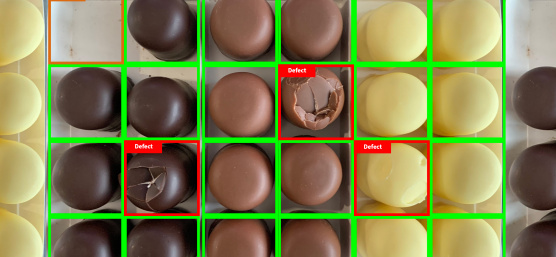
Hartmann: Our development department is always working on practical demo projects. For example, we simulated a quality test for foam kisses. Our intelligent IDS NXT camera system quickly and reliably detects every crack, dent and other quality defects. Another possible example is the detection of nuts in nut chocolate. It is checked for intactness and even distribution per sheet. With such demos the sales department can show the advantages and functionality of the system. The potential savings are usually substantial and quickly amortize the cost of the system. You can achieve high success rates with relatively little effort.
FOOD-Lab: What do you estimate: how many pictures would you need to check the correct distribution of nuts?
Schick: You won't achieve 100% recognition rate with 50 images, but you will certainly get relatively close.
Hartmann: In view of the high cost pressure and the very low rate of automation in the food industry to date, an initially partially automated solution can mean a real improvement. E.g. In quality testing or product classification, production costs and time can be saved directly.
FOOD-Lab: Where do you see applications in the food industry?
Schick: Think about fish processing. The camera tells the robot how is the fish lying on the belt, where is the back, the caudal fin, etc. in order to be able to process it further. Such and similar questions also arise in the meat industry, when testing the quality of fruit and vegetables and the confectionery described. Another application concerns bakeries, i.e. the detection of bread browning from the outside. It concerns e.g. also the packaging of toast in boxes, where the correct distribution of the packages is important.

Hartmann: We also use camera systems in agriculture, keyword precision farming. The use of herbicides is to be reduced through the targeted identification of crops and weeds. Another issue is product maturation.
FOOD-Lab: Then we come to classics like Parma ham or Parmigiano cheese. Up to now, this has been checked using classic acoustic methods, for example tapping the ham to determine whether the meat has detached from the muscle, which would be unacceptable.
Hartmann. Such problems can certainly also be solved by intelligent camera systems if the corresponding parameters can be defined optically. There are a large number of applications that we cannot even imagine today. We are excited to see which challenges in the food industry we will be able to master in the future. According to our motto "it's so easy", we want to offer simple solutions here too.
Thank you very much!
Vision Channel
Videos and live sessions about machine vision.
Your project
How can we support you in your project? Together we will find the right solution for you!
Newsletter
Stay up to date and subscribe to our newsletter.