

Technology Meets Participation: With IDS cameras, vvvv and SCHNELLE BUNTE BILDER (FAST COLOURFUL IMAGES), history gets interactive
Interactive installations
At a glance
- Industry: museum, media art and interactive exhibition systems
- Camera: GigE uEye CP (GV-5280CP Rev. 2.2) und uEye XCP (U3-3680XCP-NIR Rev.1.2)
- Task: capture and real-time integration of visitor movement for interactive, participatory exhibition installations
- Challenge: reliable detection of people under changing lighting conditions and overlapping projections without visual interference
- Solution: combination of industrial cameras, NIR technology, YOLO tracking, and the vvvv real-time platform for low-latency processing and visualization
- Customer benefit: immersive, reliable, and flexible interactive experiences with easy integration into creative real-time systems
On December 9, 2025, the new permanent exhibition “You Are Part of History” opened at the Haus der Geschichte (House of History) of the Federal Republic of Germany in Bonn. The focus is on getting involved: Visitors should not only learn about the exhibits, but also actively immerse themselves in historical narratives, shape the content, and leave their own traces. This new form of participation is made possible by the close collaboration between SCHNELLE BUNTE BILDER, the Haus der Geschichte Foundation, the vvvv real-time platform, and industrial cameras from IDS Imaging Development Systems.
Media artist Sebastian Huber and his team at SCHNELLE BUNTE BILDER have been developing interactive installations for years that blend art, technology, and communication. In doing so, they make extensive use of vvvv, a visual programming environment for real-time applications. It is particularly well-suited for generative visualizations and is ideal for 3D environments and installations in a museum setting.
“The interplay between industrial products and creative software is fascinating,” emphasizes Sebastian Huber. “IDS provides us with robust, precise hardware, and vvvv gives us the flexibility to use it creatively in real time.”
IDS cameras are in use at several key locations throughout the Haus der Geschichte. The first interactive media formats were tested as early as 2022 in the experimental “#Proberaum,” and these are now being incorporated into the new permanent exhibition.
First stop: The Prologue – “You Are Part of History”
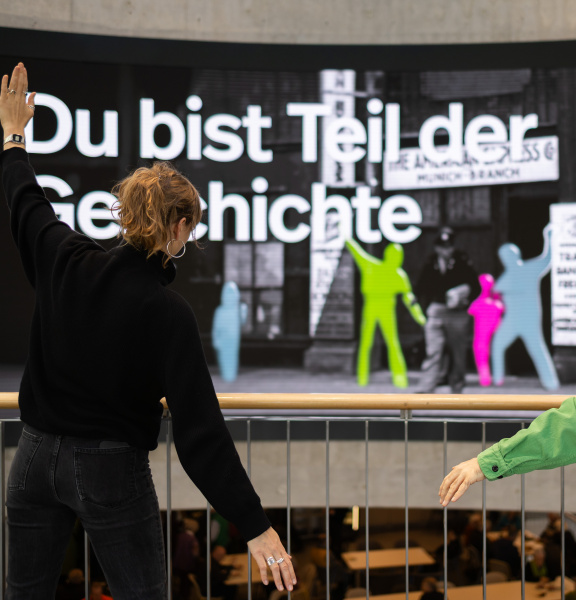
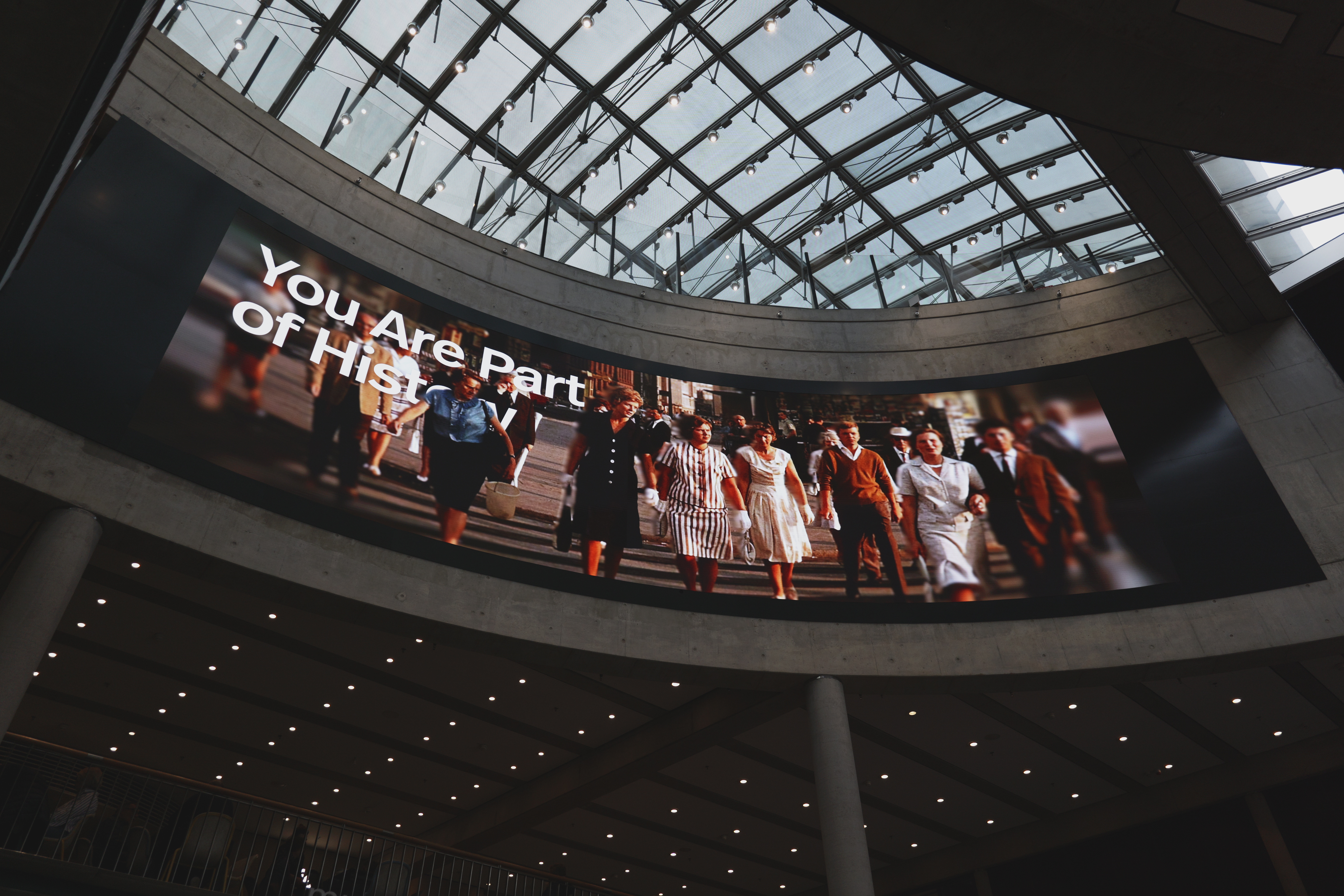
In the exhibition’s prologue, a large LED screen projects historical scenes in which visitors are integrated in real time, introducing them to the theme “You Are Part of History.” A GigE Vision industrial camera from the uEye CP series is used to detect and capture up to 40 individuals at the same time.
The camera uses Sony's compact IMX264 CMOS sensor, which, thanks to its high light sensitivity and wide dynamic range, captures motion with precision even in changing lighting conditions and under bright lighting. The captured image data is fed directly into vvvv via the IDS peak SDK, which responds in real time and triggers the corresponding visualizations on the wall.
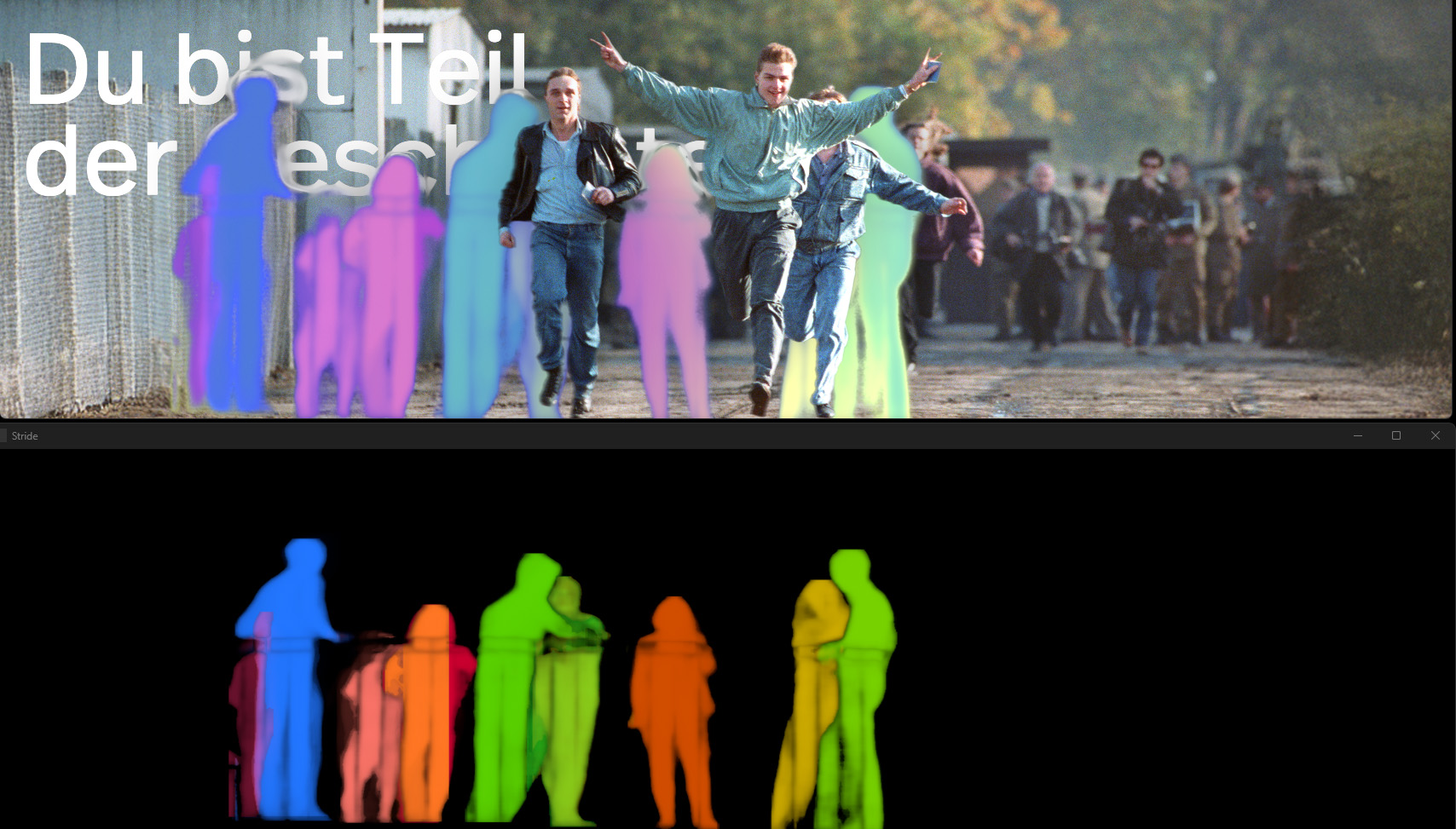
Huber describes the challenge as follows: “The camera must reliably capture visitors even under challenging conditions, such as fluctuating lighting, obstructing railings, and a very wide-angle field of view.” The combination of hardware stability and software flexibility is crucial in this regard. “IDS cameras offer a wide selection of sensors, flexible interfaces via USB 3.0 or GigE Vision, and, above all, easy integration via the IDS peak SDK, which gives vvvv developers direct access to all parameters.”
Second stop: “When were you born?” – Touch history with your own hands
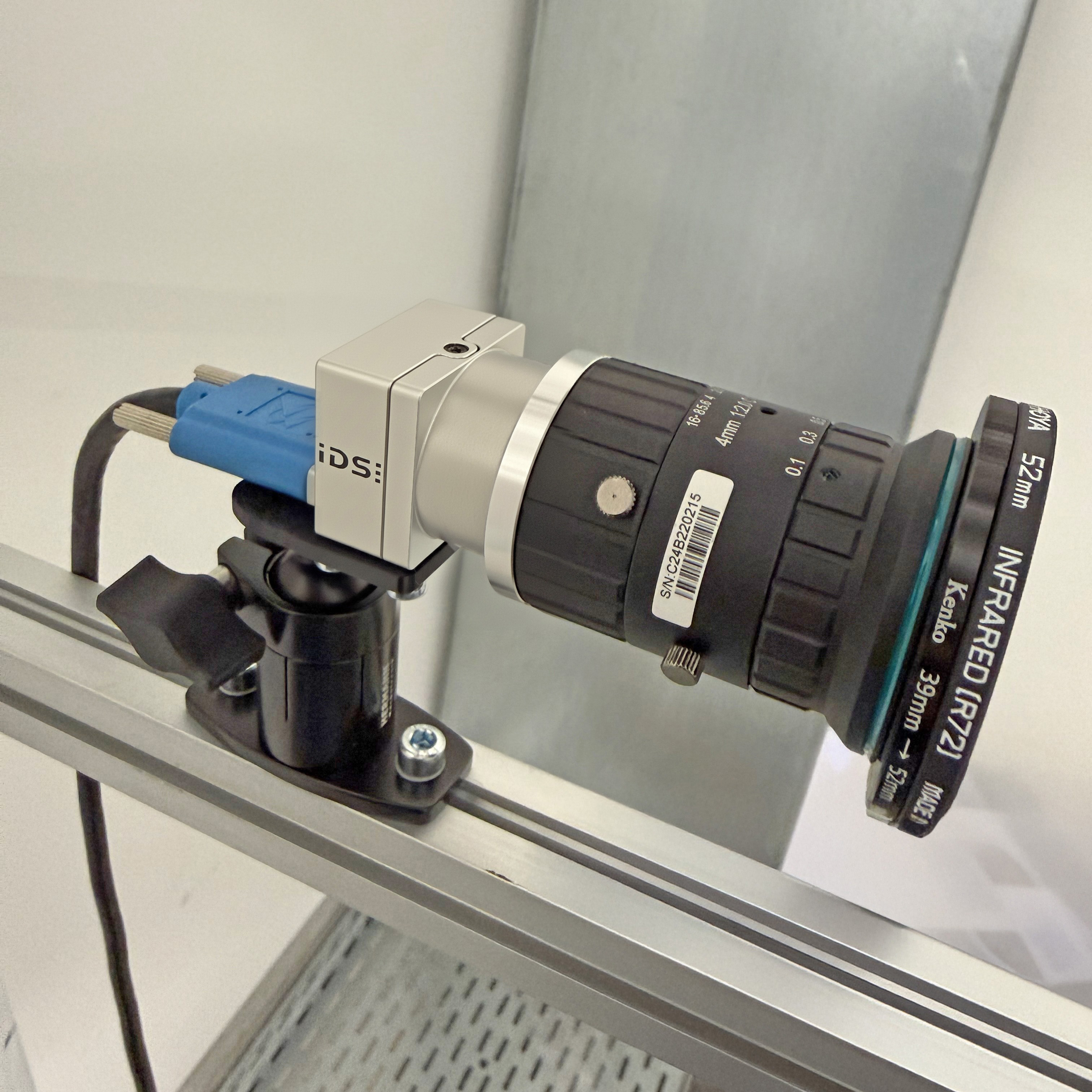
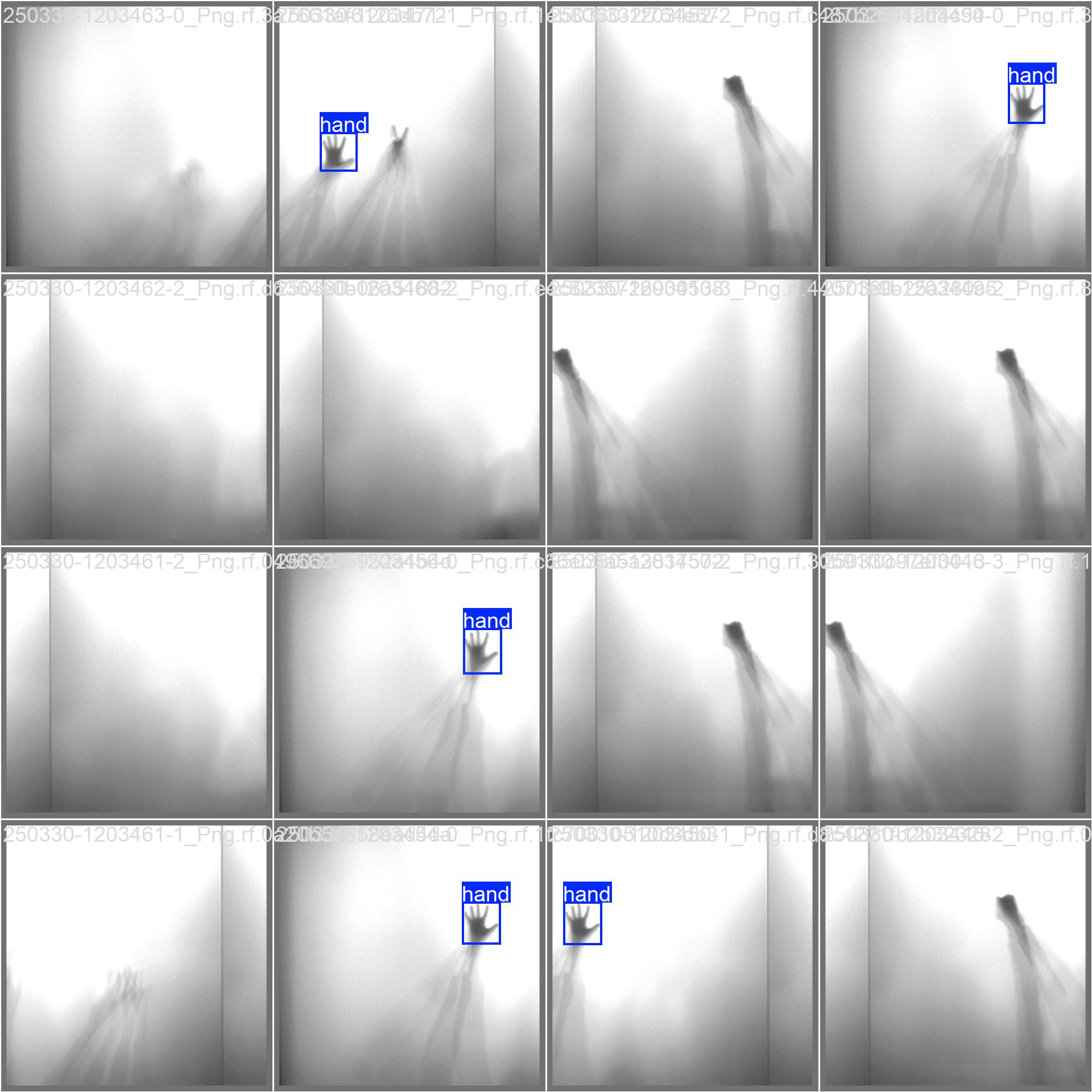
At another station, visitors place their hands on a projection screen. Their handprint opens images from their year of birth and their youth. Two cameras from the uEye XCP series, model U3-3680XCP-NIR, capture the movements. Huber explains the difficulty: “The camera must be able to recognize people without being confused by the projection. This is the only way the projection can respond to the people around it without creating feedback loops.”
The selected IDS cameras are ideal for this purpose. They transmit data via SuperSpeed USB at 5 Gbps and are equipped with an NIR (near-infrared) bandpass filter. This filters out unwanted reflections and ensures reliable detection even in brightly lit environments. The built-in 5-megapixel sensor AR0522 with BSI pixel technology delivers high light sensitivity, low noise, and strong performance in the near-infrared range - all while consuming little power. The movement data is fed in real time into a collective portrait that highlights the diversity of the visitors.
“The cameras provide us with motion data without becoming part of the visual scene. This is crucial for immersive storytelling: Technology must be perceptible without being visible.”
Tracking was implemented using YOLO - a machine learning algorithm that detects objects in image data. It runs extremely fast and even works in real time on a graphics card. “For hand detection, we use the simplest form of ‘Object detection’,” explains Sebastian Huber. It provides the position and size of the detected objects. The screenshot displays the blue bounding boxes generated by YOLO around the hands. For this purpose, Huber and his team developed a custom YOLO model through fine-tuning. “It now reliably detects ‘infrared hands,’ but does not respond to fists, for example.”
Technology for real-time interaction
Sebastian Huber highlights the performance and versatility of the IDS cameras: “The uEye cameras deliver high performance, can perform image corrections such as gain adjustment on their own, and offer all the features essential for interactive installations in real time. Particularly convenient is the fact that the cameras can be custom-built on request - from the choice of lens and sensor to USB or GigE versions. As custom-made products, they can be tailored precisely to the requirements of any installation. At the same time, they are robust, durable, and reliable.” Joreg, a co-developer of vvvv, adds: “For projects like the interactive installations at the Haus der Geschichte, vvvv is ideal because - depending on the application - it simply lets you get things done faster.”
The combination of IDS camera technology and vvvv enables precise, low-latency real-time interaction. The cameras detect movements in real time and immediately translate them into media responses. Their compact, robust design and flexible lens options make them easy to integrate into the museum's architecture. The high infrared sensitivity ensures reliable detection even under complex lighting conditions, while the IDS peak SDK guarantees a stable connection to creative real-time systems.
Museum of the Future
Where traditional sensor technology ends, interaction begins: Visitors become part of the artwork themselves. With its new installations, the Haus der Geschichte Bonn demonstrates that modern image processing can be much more than just a technical function- it becomes a narrative tool that makes history visible in the truest sense of the word. Visitors become active participants, and the boundaries between viewer and exhibit begin to blur. IDS cameras provide the precise imaging foundation, vvvv serves as the dynamic control center - and SCHNELLE BUNTE BILDER combines the two into a narrative space where past and present come into motion.
Through the interplay of IDS cameras, vvvv programming, and the artistic vision of SCHNELLE BUNTE BILDER, an exemplary model of the museum of the future emerges - a space where technology, art, and memory converge.
IDS peak and vvvv: Direct Connection for Creative Real-Time Projects
To ensure that the cameras can fully demonstrate their capabilities in creative applications, vvvv relies on a tight technical integration with IDS peak. This makes the developers' work much easier: All camera functions are immediately available in vvvv without the need for complex SDK integration. The API can be precisely controlled, and IDS’s wide range of hardware, from lenses and sensors to compact designs, remains fully available.
Joreg, a co-developer of vvvv, describes the approach as follows: “We want to provide direct support for as wide a range of hardware as possible. In response to numerous customer requests, we have integrated IDS peak. This means users can now access all the features of their IDS cameras with just a few clicks, without having to worry about SDK integration themselves. Many people specifically choose IDS because their lenses, compact design, and API control offer significantly greater flexibility than consumer products.”
Since vvvv is based on the .NET Framework, extensions can be easily integrated via NuGet. The VL.Devices.IDS package provides direct access to the IDS peak functions, making it particularly easy to integrate the cameras into vvvv: https://www.nuget.org/packages/VL.Devices.IDS
vvvv - Dießl & Gregor, GbR

vvvv is a real-time visual programming environment for .NET. It is used internationally in media art, generative graphics, and interactive interfaces. The company provides software solutions that enable creative professionals to quickly develop complex real-time applications, translate motion and data directly into visual experiences, and design interactive spaces.
SCHNELLE BUNTE BILDER – Huber-Pohle-Timpernagel GbR

SCHNELLE BUNTE BILDER is a studio specializing in media art and digital interaction. It creates immersive, interactive spaces where visitors can explore content in a playful way, interact with one another, and help shape artistic experiences themselves. The team combines cutting-edge technologies, creative concepts, and participatory formats to reimagine exhibitions, performances, and events.
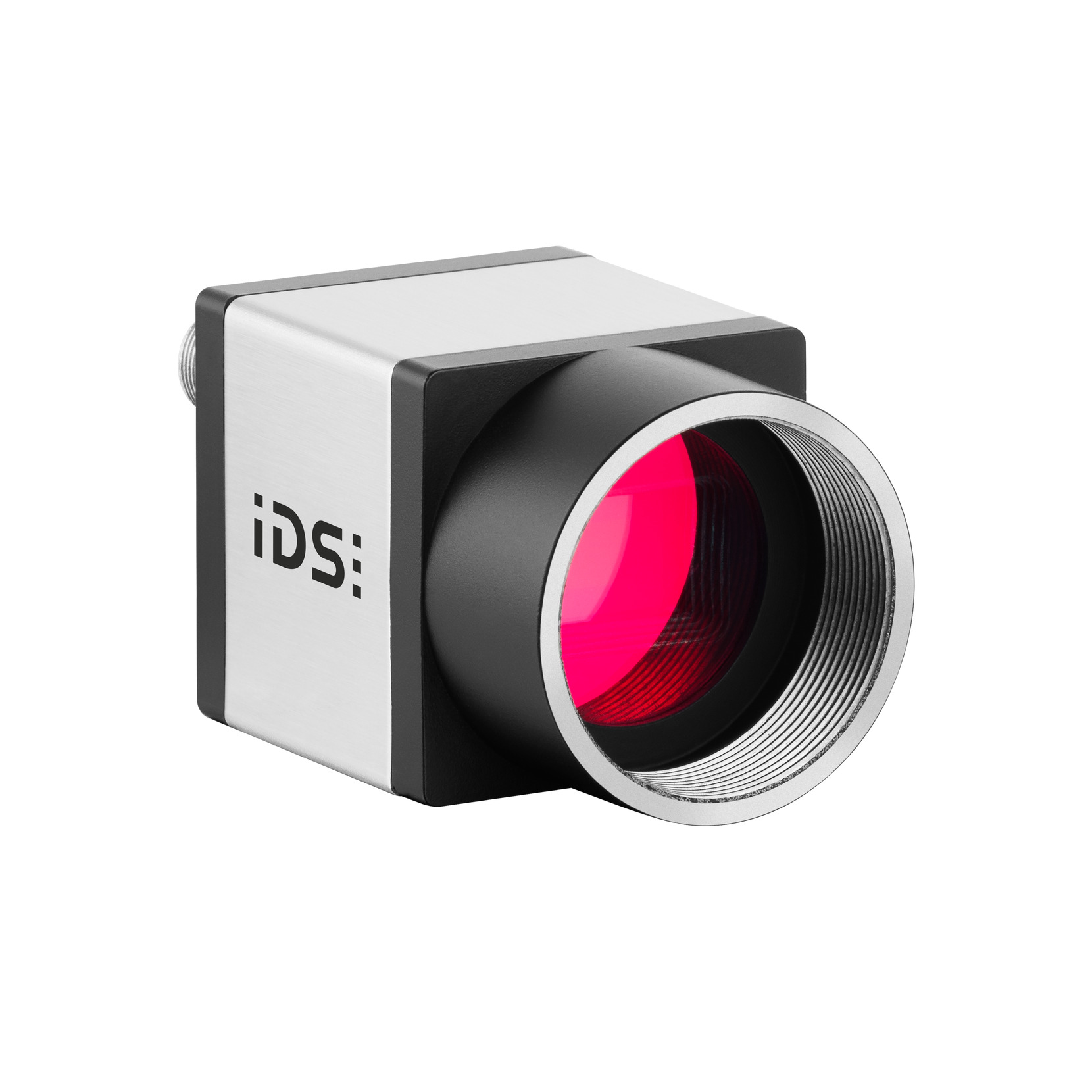
uEye CP
Model used: GV-5280CP Rev.2.2
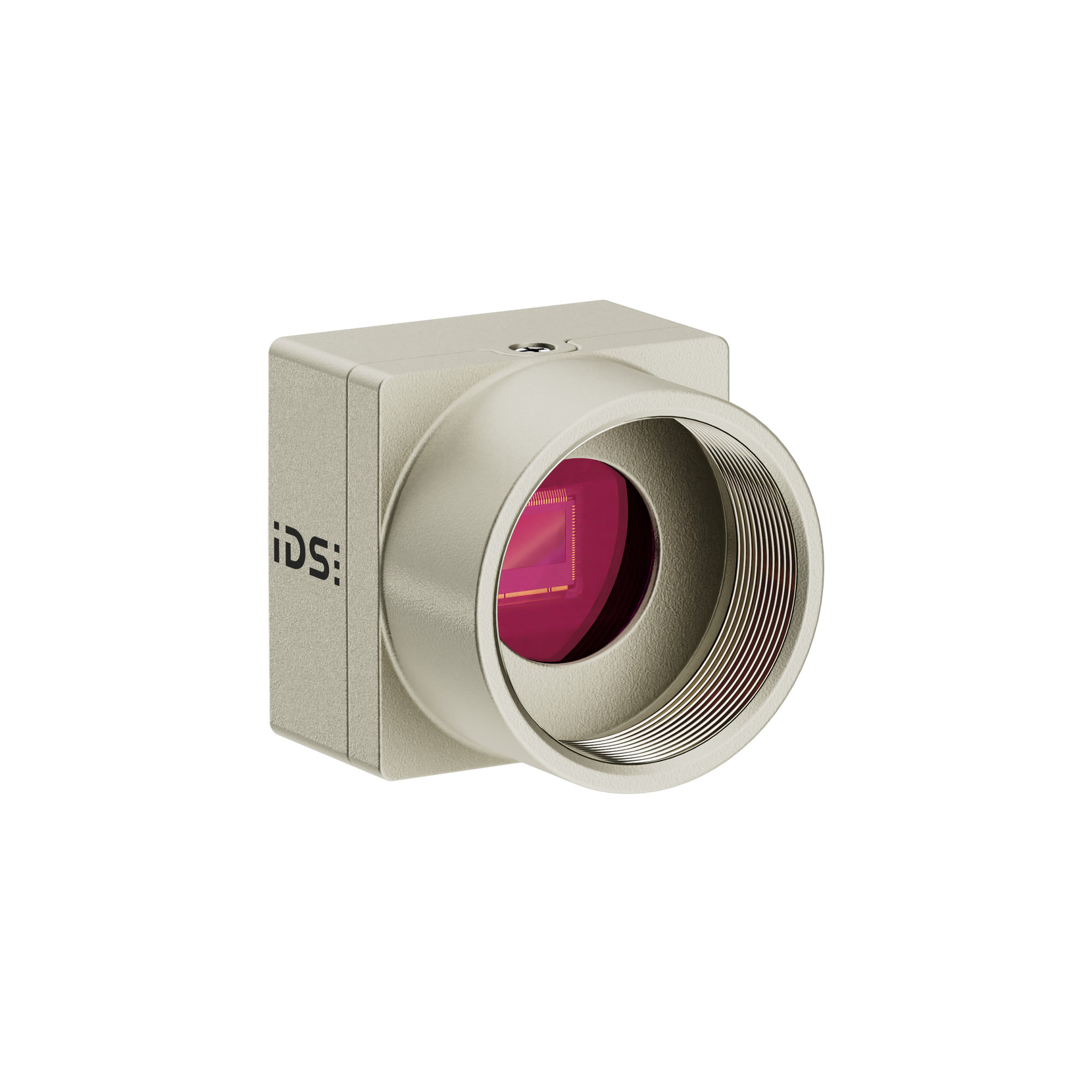
uEye XCP
Model used: U3-3680XCP-NIR Rev.1.2