Smart farming with a system: Cost-effective automation with image processing for family-owned businesses
AI-powered potato sorting
At a glance
- Industry: agriculture / smart farming / food processing / potato sorting
- Camera: GigE uEye FA (GV-51F0FA Rev. 1.2)
- Task: automated sorting of potatoes and onions based on quality parameters and defects
- Challenge: high labour effort and difficulty in consistently identifying diverse damage patterns under cost pressure
- Solution: AI-based multi-camera system with 360° imaging, real-time analysis and pneumatic sorting mechanism
- Customer benefit: reduced labour requirements, consistent sorting quality and cost-effective automation for smaller farms
Rising quality standards, increasing cost pressures, and labor shortages pose significant challenges for agricultural businesses. It is particularly important for direct sellers and family-run businesses to reliably ensure product quality while operating efficiently. Smart farming solutions that automate processes and are cost-effective even for smaller operations are therefore gaining in importance.
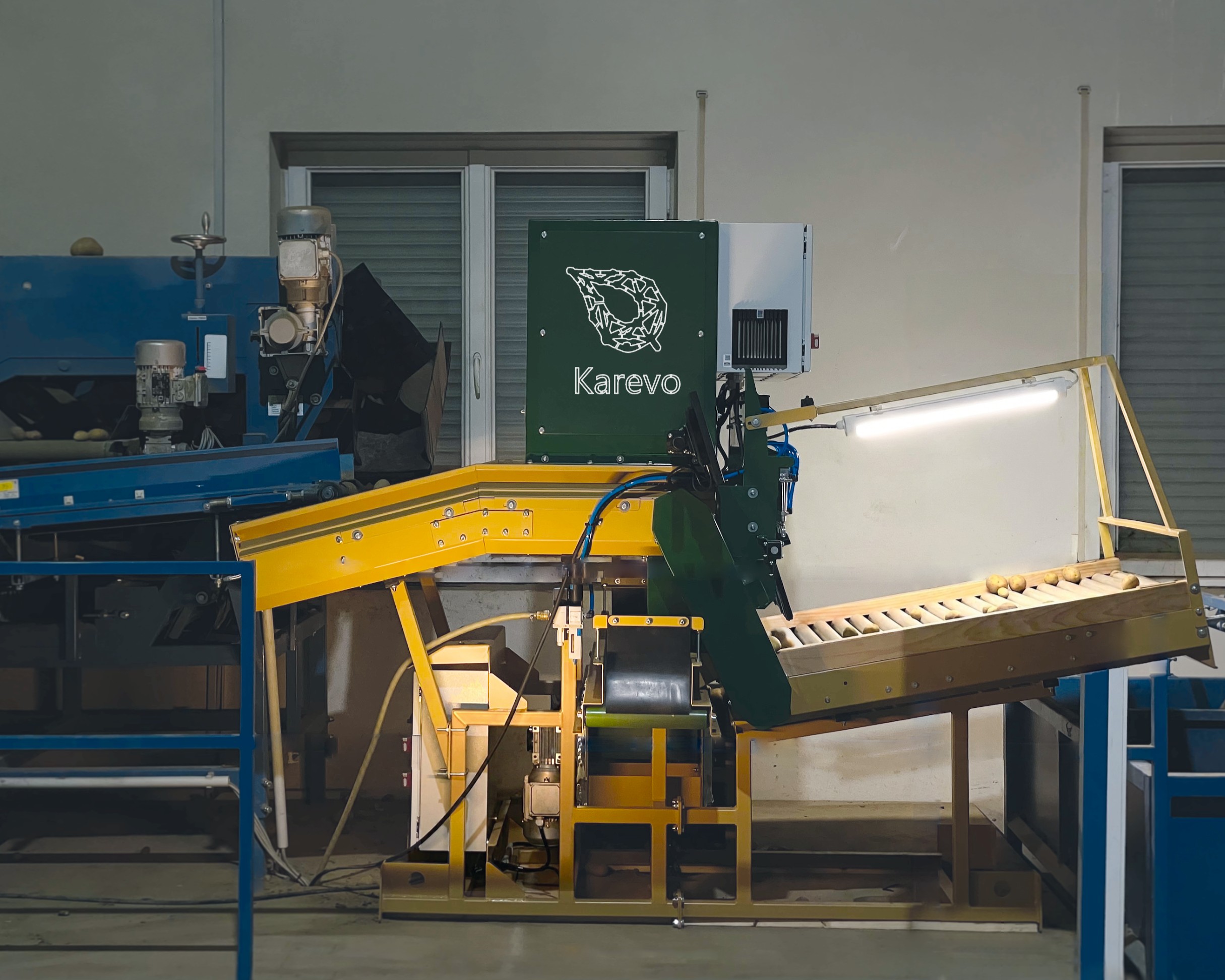
With the Karevo DUO85, built using industrial cameras from IDS Imaging Development Systems, Karevo offers a solution that addresses this very need: The system reliably automates the sorting of potatoes and onions, making AI-powered image processing economically viable even for smaller farms.
Challenge: Ensure quality, reduce costs
Sorting potatoes and onions by hand is time-consuming and labor-intensive. Various types of damage, such as growth cracks, wireworm infestation, dry and wet rot, deformities, mechanical damage, or green discoloration, can only be consistently identified with considerable effort.
Benedikt Keßler, co-founder and CEO of Karevo, emphasizes: "The Karevo DUO85 was developed with the aim of making optical sorting technology accessible to direct sellers and family-run farms. This enables even smaller businesses to embrace digitalization and efficiently automate their processes. The system ensures consistently high product quality and reduces the workload for staff during sorting."
Solution: AI-based vision technology for potatoes and onions
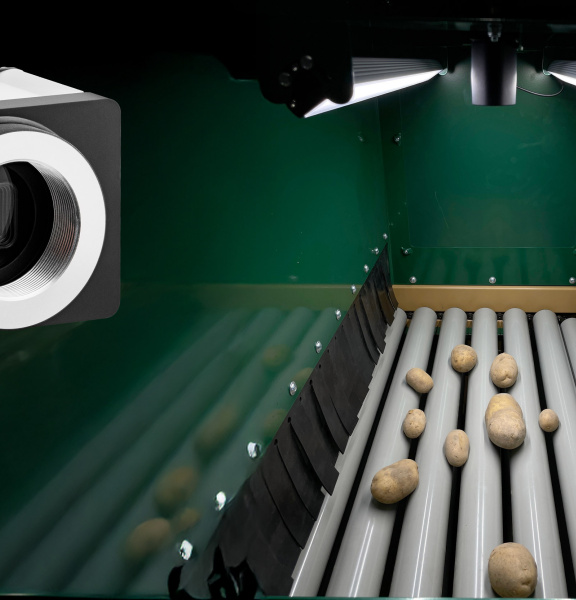
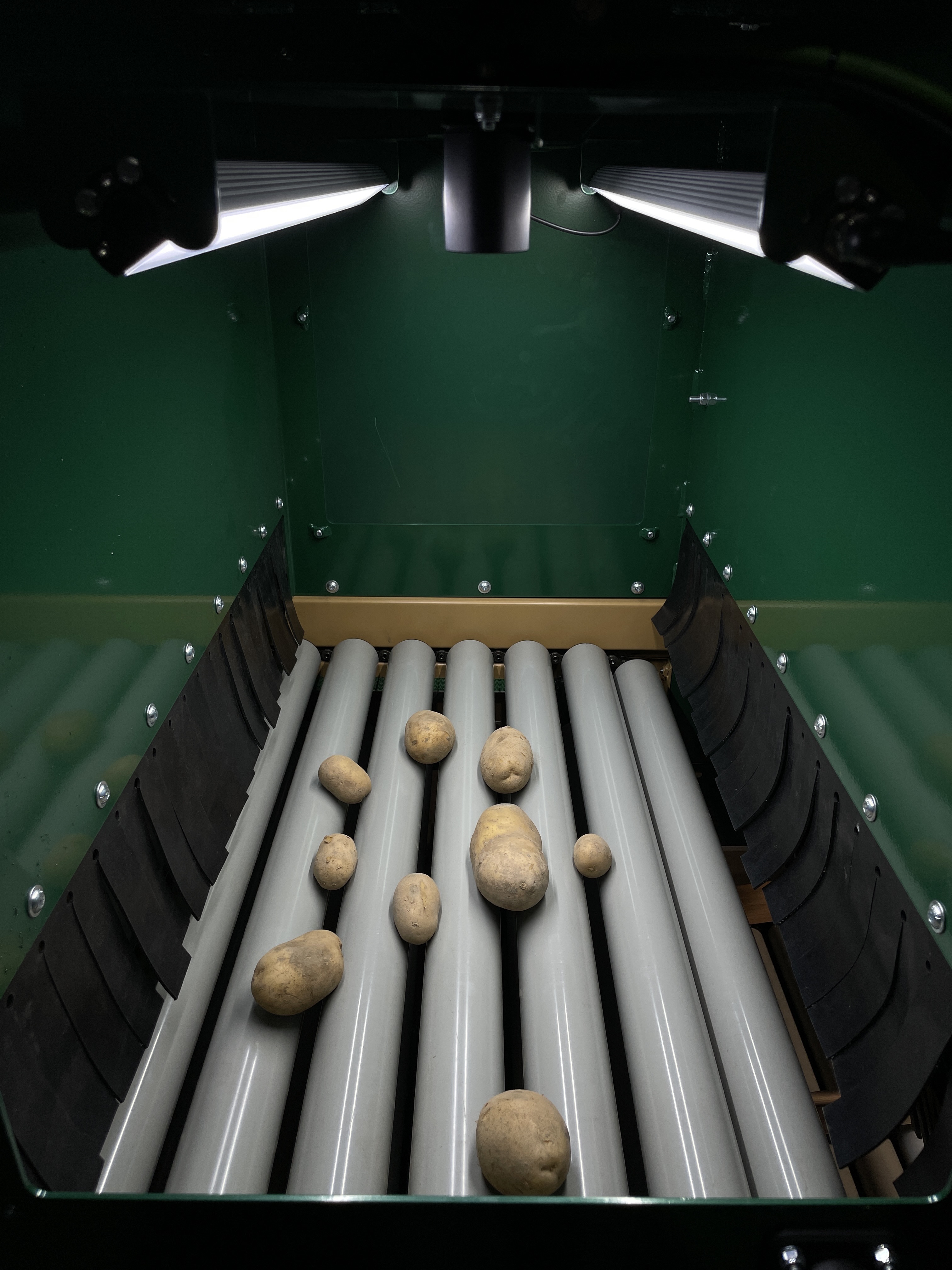
The Karevo DUO85 fully automates the sorting process. Depending on the system configuration, two to eight GigE Vision cameras from the IDS uEye FA series are used. These capture every tuber from all angles and provide a complete 360° view of its surface. The system takes over 15 images per potato and analyzes them in real time using a high-performance computer.
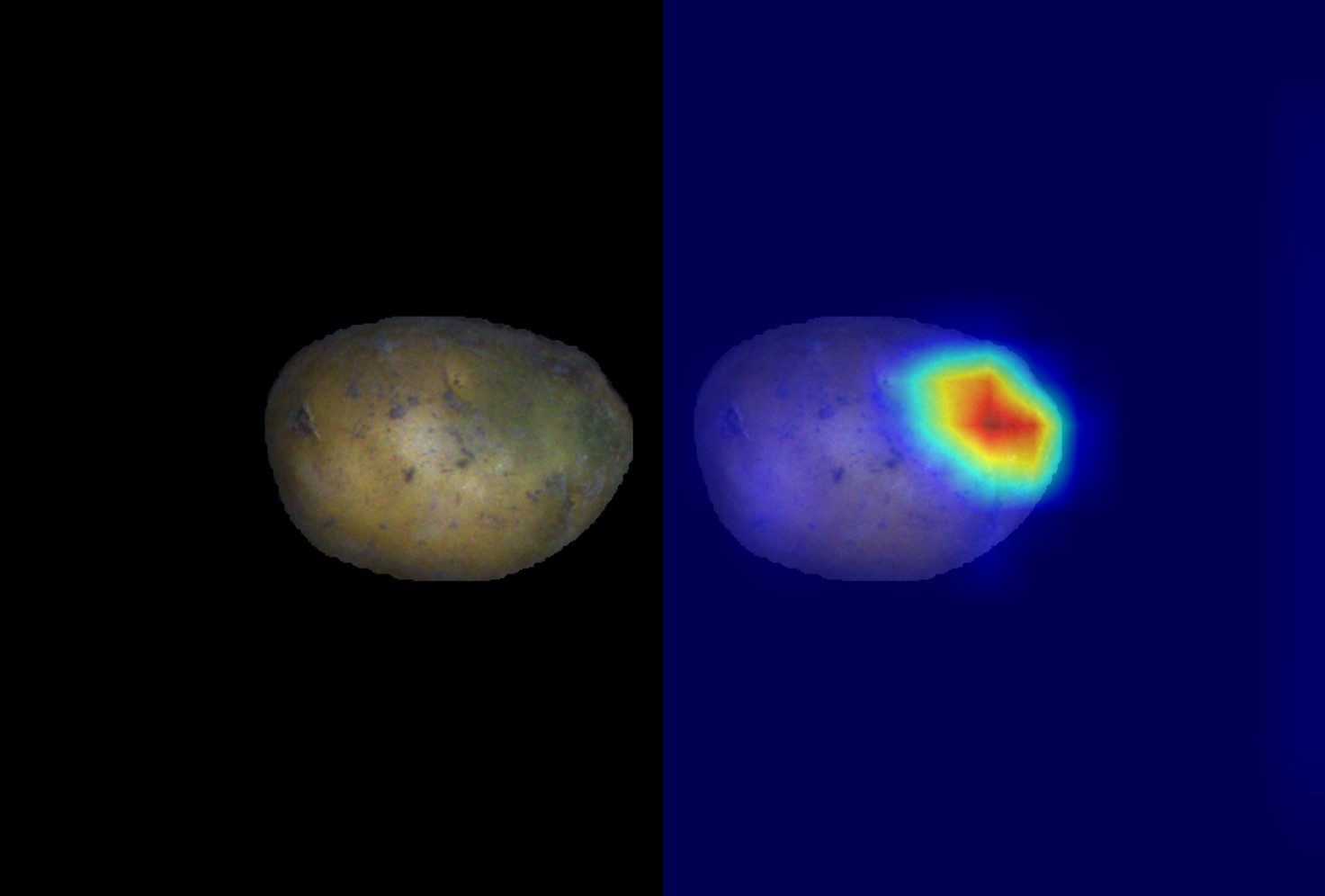
The image data is transmitted to custom-developed software that uses artificial intelligence to evaluate characteristics such as size, defect type and severity, shape, and other quality parameters. The AI detects the seven most common quality defects with pixel-level precision and up to 95% accuracy, while simultaneously assessing their intensity and size. In addition to potatoes, the DUO85 also sorts yellow and red onions, including reliable foreign object detection: Stones and clods are reliably removed from both potatoes and onions.
The AI models used are designed for stable, real-world operation and can be further optimized as needed using additional image data - for example, when dealing with heavily soiled crops or specific varieties.
Based on this analysis, the system controls a pneumatic finger system - a compressed-air-powered diverting and sorting system in which individually controllable, finger-like actuators precisely and gently divert products from the conveyor stream in sync with image processing. This ensures that damaged tubers or those that do not meet specifications are reliably separated.
Result: Consistent sorting results, reduced labor requirements, and a stable, continuous throughput of up to 5 tons per hour - a clear economic advantage for businesses of all sizes.
Economic benefits: Getting started with a manageable investment
A key goal in the development of the DUO85 was to make it easy to get started. The system is specifically designed for direct sellers and family-run businesses that have had little access to AI-powered image processing and computer vision technology until now. "With the DUO85, we’re making it possible for even smaller businesses to get onboard with digitalization," says Keßler. "Our customers benefit from consistently high product quality, a significant reduction in the workload on staff, and more efficient processes - without high investment costs."
Profitability always depends on individual operational structures. Karevo typically estimates that the system will eliminate the need for one to two (temporary) employees, which in many cases results in a payback period of about two to three years.
Pricing is specifically designed for small and medium-sized businesses to optimize return on investment and ensure profitability. In addition, the system is modularly scalable and can be flexibly adapted to businesses of various sizes - an important factor for long-term investment security.
Camera technology from IDS: Rugged, powerful, and easy to integrate
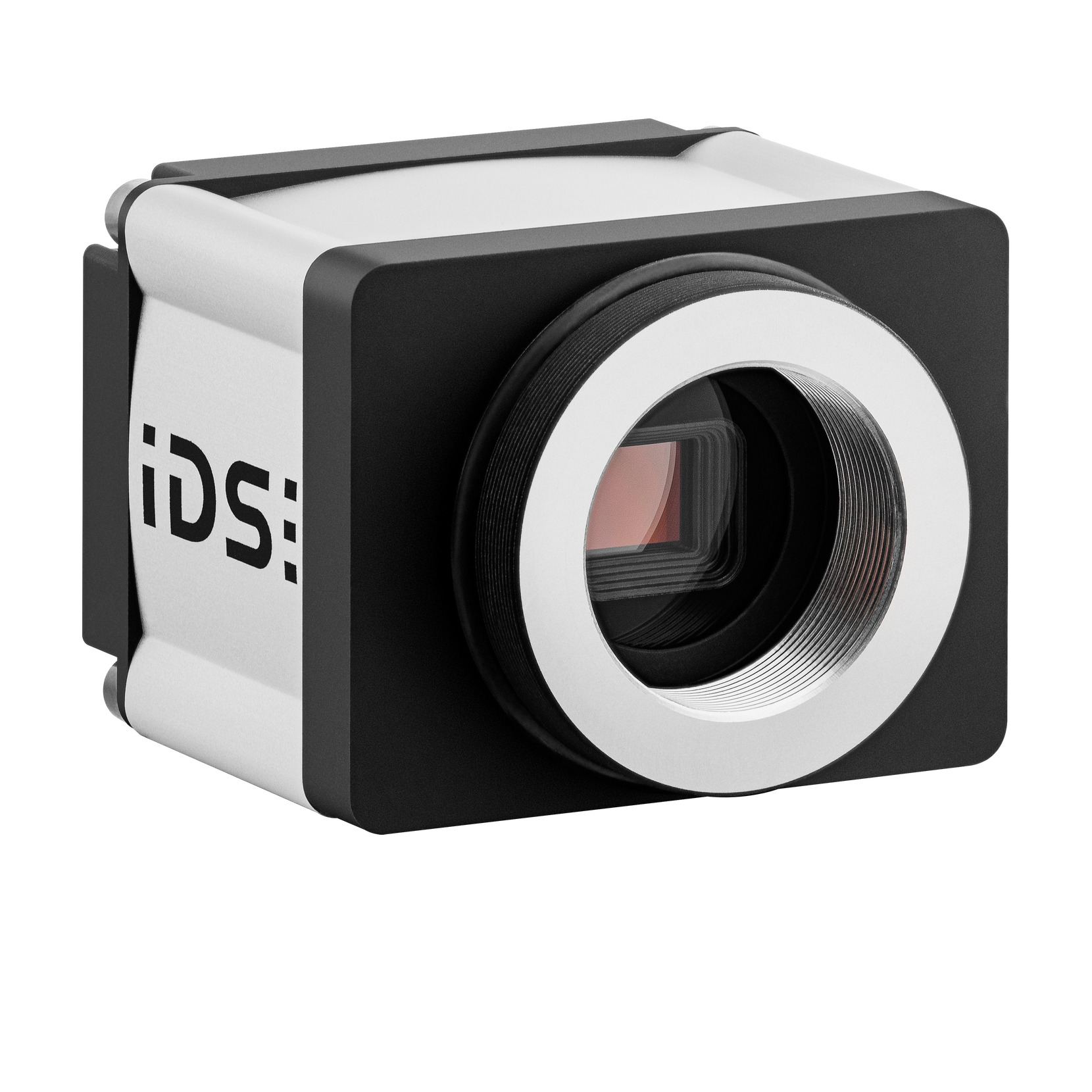
Karevo uses IDS uEye FA cameras with GigE Vision Standard equipped with the 5.10 MP Sony IMX547 sensor from the Pregius S series. Thanks to global shutter and BSI (back-side illumination) technology, these cameras deliver excellent image quality, even under challenging lighting conditions in sorting and processing areas. The rugged design, featuring IP69K protection, screw-lock connectors, and an extended temperature range, makes these cameras ideal for use in harsh agricultural environments. Features such as on-camera preprocessing also reduce the amount of computing power required.
Jürgen Hejna, Product Manager 2D Machine Vision at IDS, describes it as follows: "For applications such as those in the DUO85, reliability, durability, and easy integration are key factors, in addition to image quality. The uEye FA cameras offer exactly these features and enable stable multi-camera operation with minimal integration and maintenance requirements."
Quick integration and future-proofing with IDS peak
Another economic benefit comes from using the IDS peak SDK. "Using IDS peak allows us to integrate the cameras into our system quickly and reliably. Thanks to optimized control, parameterization, and diagnostic functions, we can ensure high image quality and reliable performance in agricultural applications. At the same time, we benefit from long-term compatibility and reduced development costs for future system expansions," explains Benedikt Keßler.
The user-friendly interface makes complex AI technology easy to use. Parameters can be adjusted intuitively, different sorting profiles can be easily switched, and detailed reports are available at the touch of a button. The DUO85 integrates seamlessly into existing sorting lines and operates as a standalone optical sorting system tailored to specific requirements.
"Thanks to optimized control, parameterization, and diagnostic functions, we can ensure high image quality and reliable performance in agricultural applications."
Outlook: Vision Technology for the Agriculture of Tomorrow
The current focus is on automated quality inspection of potatoes. This opens up a wide range of possibilities for further applications - potential that Karevo intends to tap into in the future. "Computer vision applications in agriculture are becoming increasingly important." It is crucial to use rugged and reliable camera systems that are specifically designed for use in demanding outdoor environments," says Keßler.
Karevo GmbH

Karevo develops AI-powered sorting systems for quality control of table potatoes, seed potatoes, and onions. The machines reliably detect defects and foreign objects, relieving companies of the burden of manual sorting. Karevo is a spin-off of the Technical University of Munich (TUM), founded in 2024 by Benedikt Keßler, Felix Beck, and Johannes von Wittke.
uEye FA
Model used: GV-51F0FA Rev.1.2