

Compact 3D scanner with space-saving board-level industrial camera from IDS
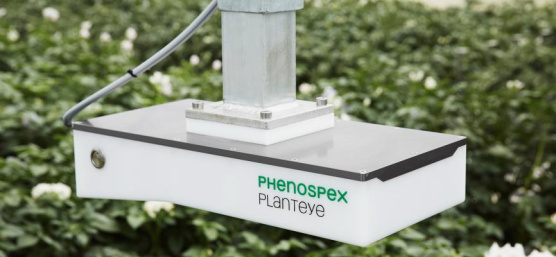
Watch your plants grow
The light section method is a widely used method in 3D measuring technology. This method is very precise, insensitive to external light, and also suitable for mobile solutions. The company Phenospex has now developed a 3D scanner based on this method, which offers fully automated measurement of plant height and volume. This technology can be used, for example, to assist research in the area of plant breeding, or to help make industrial plant production more efficient. A board-level industrial camera from IDS, which is integrated into the PlantEye scanner, captures the laser's reflected light beam. The camera requires very little space and offers a high degree of sensitivity in the NIR range. Its impressive price-performance ratio and a future-proof driver design also make it attractive to OEM customers.
PlantEye system
The PlantEye system enables automatic analysis of plant growth in plant research and breeding, as well as automated plant cultivation in industrial plant production. The system is used to record plant productivity and enables a more efficient use of resources such as water, fertilizer and pesticides. It also allows for the early detection and correction of any undesirable developments in the plant cultures. The solution is used by large seed corporations, universities and public research bodies, for example to measure and optimize plant performance under various environmental conditions. However, the target customers for the system also include producers of ornamental plants, who must supply their plants to retailers at a specific point in time while also ensuring that the plants meet the size specifications in the order. The system was developed by Phenospex, a spin-off of the research center at Jülich, which today has its headquarters in Heerlen in the Netherlands.
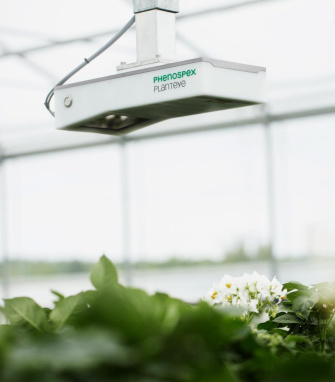
3D scanner, terminal and software
PlantEye consists of three modules, i.e. a 3D scanner, a terminal and software. A transport system moves the scanner over the beds or stands in which the plants are growing. It communicates wirelessly with the terminal, which can be accessed via browser from any laptop or touch-enabled device. This allows researchers to view the current plant growth in tables and graphics, enter steps to be taken for cultivation of the plants, and document the entire crop. The third module in the system is the PlantEye software, which analyzes the plant cultivation process, plant development and climate data, and pinpoints areas where there is a potential for optimization.
The software enables secure, long-term storage in a central database. It is compatible with the greenhouse's climate control system and has an import function for other external sensors. For example, the screen also displays the latest weather data and forecasts. The plant stands are divided into grid cells, and a host of different parameters can be visualized for each cell. As a result, deviations are easily spotted.
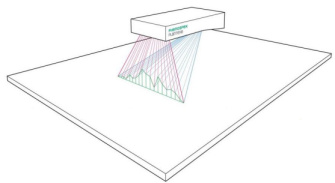
The mobility of the scanner makes this a very powerful system
Within just two hours, the scanner can cover up to 4,000 m², automatically determining leaf area, plant volume and elongation growth for all cultures within that area. To do so, the scanner uses the light section method, which is ideal for this application. An integrated laser projects a line of light in the direction of the object to be measured, and the camera captures the line of light as an image from a different direction. In accordance with the principle of triangulation, all object coordinates that lie on the plane of light can therefore be calculated. In this way, the camera's 2D image is used to create a 1D height profile. This comparatively simple sensor configuration allows for a very compact design. The PlantEye 3D scanner measures just 420 x 200 x 95 mm and is extremely robust. This ensures that the delicate technology is adequately protected against the rather harsh conditions in the greenhouse, including water splashes and high temperatures.
Phenospex has integrated a board-level industrial camera from IDS into the scanner
The UI-1221LE model has a Mono-CMOS-Sensor with WVGA resolution (752 x 480), a USB interface and an S-mount lens mount. With dimensions of no more than approx. 3.6 x 3.6 x 2 cm, the camera is designed to fit into the tightest of spaces. It also delivers very high sensitivity in the near-infrared region. Both of these features are of crucial importance to Phenospex. The camera's space-saving design allows it to be mounted in the center of the scanner housing. A mirror then directs the camera's light beam towards the plants. As a result, the scanner achieves a large field of view and scan width even at short distances. The sensor's high degree of sensitivity in the NIR range also meant that Phenospex was able to use a 930 nm laser with a wavelength that ensures a good reflection of the plants. Yet another benefit of the USB 2.0 board-level camera is its relatively high frame rate (almost 90 fps), which plays a role in determining the speed at which the scanner can be moved over the plants. In the light section method, the sensor setup has to be moved over the object so that a 2D height profile or 3D point cloud can be generated from a 1D height profile. At a measuring speed of 50 mm/s, the PlantEye system achieves a resolution in the range of millimeters.
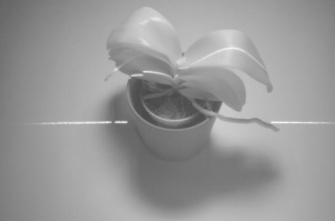
Finally, the point clouds are analyzed and segmented. The plant is cropped out of the image, its leaves are detected and the leaf area is measured. Height is also evaluated. All parameters are then available to users in a database. To optimize performance, in other words, speed, Phenospex uses a program it has developed itself in C++ rather than standard image analysis software. This program takes less than a second to extract the parameters specified above from the raw data.
The uEye API serves as an interface between the PlantEye software and the camera
The interface is part of the IDS Software Suite and supports all sensor features of the board-level camera. The camera package from IDS includes the SDK for Windows and Linux (32- and 64-bit) and is the same for all models – regardless of whether they have a USB 3.0, USB 2.0 or GigE connection. The benefits to OEM customers like Phenospex are two-fold. Firstly, the camera can be very quickly and easily integrated into the system. Secondly, it works with all models and interfaces. As a result, you can switch from a USB 2.0 camera to a more powerful model with a USB 3.0 or Gigabit-Ethernet connection at any time without any difficulty. The IDS Software Suite also includes demo programs for camera integration and image acquisition with the corresponding source codes in C, C++ and VB Developers can quickly incorporate these into their own programs and make any necessary adjustments. Direct interfaces are available for many other popular machine vision programs, such as Common Vision Blox, HALCON, MERLIC, NeuroCheck or LabVIEW.
Outlook
Phenospex is particularly eager to further improve the speed of the PlantEye system. With the IDS driver philosophy, you can rely on a future-proof solution that allows you to switch, at any stage, to a different camera model from the extensive IDS range. In this case, you only need to adjust the camera-specific parameters – you don't need to reprogram the application.
Phenospex

Phenospex develops smart sensors for analysing plants in any environment for plant sciences, agrochemistry and breeding.
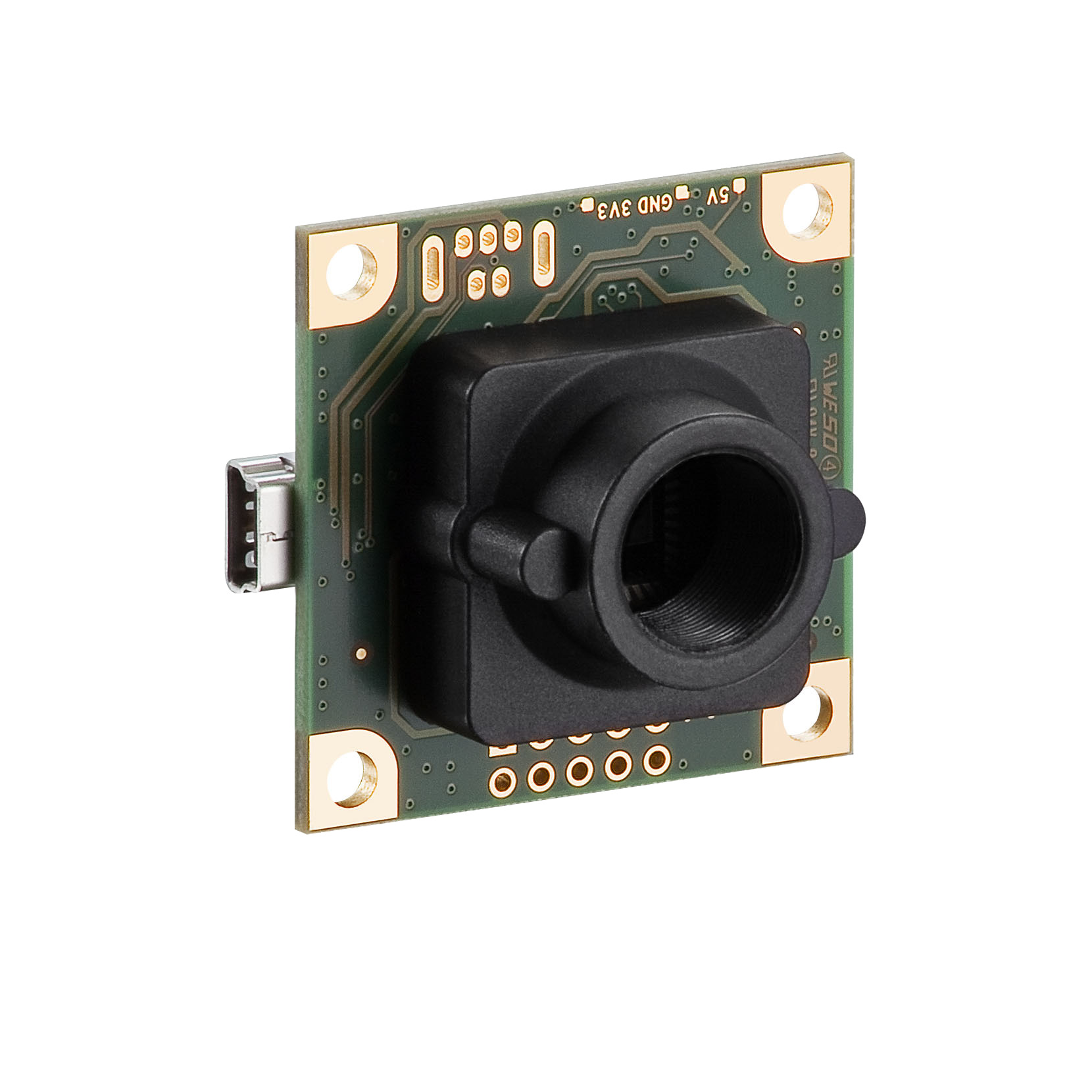
uEye LE
Model used: UI-1221LE

For over ten years, she has been creating press releases and application reports and designing corporate topics and technical product communication with corresponding expertise. Thanks to her experience in strategic B2B communication, she formulates precise messages and delivers well-founded, technically robust content - always with a focus on authenticity and clarity.
Your project
How can we support you in your project? Together we will find the right solution for you!
Vision Channel
Videos and live sessions about machine vision.
Newsletter
Stay up to date and subscribe to our newsletter.