

Which industrial cameras are suitable for parcel handling, parcel measurement, barcode reading, and track-and-trace?
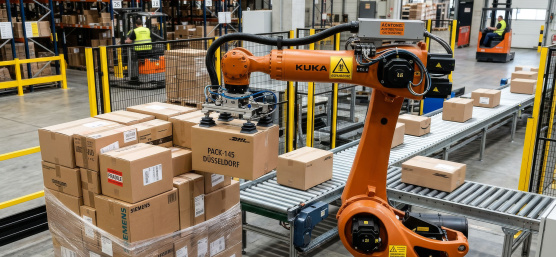
Industrial image processing performs various tasks in modern logistics centers: It detects and measures parcels, reads barcodes and shipping labels, tracks shipments, and provides robots with the necessary information for secure gripping. Which industrial camera is suitable for the tasks depends on whether 2D images, depth data, detailed 3D point clouds, or on-camera AI processing are required.
For parcel measurement and the positioning of parcels on conveyor belts, cameras with time-of-flight (ToF) technology, such as the Nion 3D-ToF camera, are suitable. The high-resolution 2D industrial cameras of the uEye family are suitable for barcode reading as well as the capture of human-readable text and shipping labels. If OCR, label classification, or AI-based inspections are to be performed directly in the vision system, the IDS NXT AI cameras are a good choice. For track-and-trace, uEye 2D cameras can be combined with the Nion 3D-ToF camera to capture position, height, and volume. For robot-assisted parcel handling, depalletizing, and bin picking, the stereo vision cameras of the Ensenso family provide precise point clouds for object recognition and gripping planning.
The specific camera selection depends on factors such as the field of view, working distance, conveyor speed, accuracy, lighting, environmental conditions, and processing architecture.
Requirements for industrial cameras in logistics applications
Whether parcel handling, parcel measurement, barcode reading, or track-and-trace: In logistics applications, industrial cameras must reliably capture parcels even at high conveyor speeds. Which requirements are particularly important depends on whether the camera is intended to read codes, determine dimensions, or track the position and movement of a parcel.
The most important selection criteria include:
- Resolution:
- It determines whether small barcodes, text, parcel edges, or height differences can be reliably detected.
- Conveyor speed:
- For fast-moving parcels, short exposure times, a sufficient frame rate, and a motion-blur-free image are required.
- Field of view and working distance:
- The camera must capture the relevant area of the conveyor belt and the occurring parcel sizes from the available mounting position.
- 2D or 3D data:
- Detailed 2D images are required for barcodes and labels. Parcel dimensions, height, position, and volume can be determined using 3D or depth data.
- Lighting and surfaces:
- Cardboard colors, reflective films, adhesive tapes, damaged labels, and changing ambient light should affect detection as little as possible.
- Triggering and synchronization:
- Image acquisition must occur at exactly the right time. For track-and-trace, identification, position, and measurement data must be clearly assigned to the same parcel.
Applications
Parcel handling
Typical application
Detecting, localizing, and monitoring parcels on conveyor belts
Recommended camera family
Nion 3D ToF camera
Key features
Real-time depth acquisition, detection of position and parcel height, large field of view, reliable acquisition of moving parcels
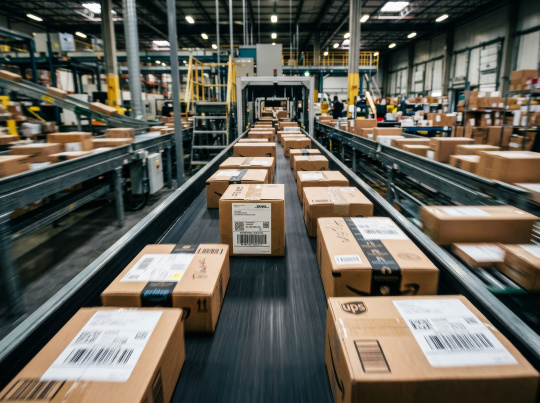
During parcel handling, the camera must detect where a parcel is located, how high it is, and which area of the conveyor belt it occupies. This allows, for example, parcels to be located, distances to be checked, jams to be detected, and subsequent sorting processes to be controlled.
The Nion 3D ToF camera provides depth information for every pixel. This allows the position, contour, and height of a parcel to be determined in real time. This is particularly suitable for dynamic conveyor technology applications where robust 3D data is required without having to perform complex stereo evaluation.
For simple presence or 2D position checks, uEye 2D cameras can also be used depending on the application.
Parcel measurement
Typical application
Determine length, width, height, and volume of parcels
Recommended camera family
Nion 3D ToF camera
Key features
High depth resolution, reliable edge detection, suitable field of view, appropriate working distance, robustness against different cardboard surfaces
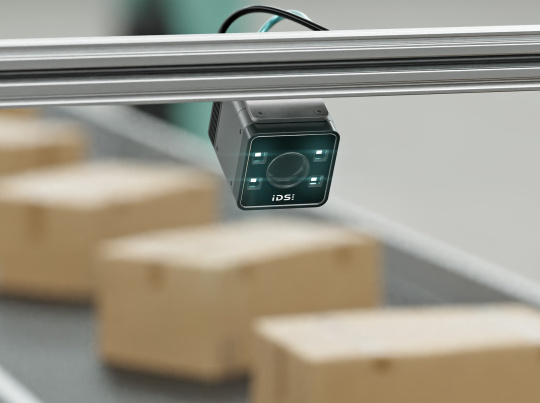
During parcel measurement, the dimensions of a parcel are recorded automatically. The obtained data can be used, for example, in DWS systems (dimensioning, weighing and scanning), which automatically measure, weigh, and identify parcels. Furthermore, the data is used for calculating volumetric weight, storage space planning, and optimizing transport capacities.
The Nion 3D ToF camera provides depth values per pixel directly. If the plane of the conveyor belt is known, the height of the parcel can be determined from it. Length, width, and volume can also be calculated using the detected parcel contours.
The required measurement accuracy, field of view, working distance, and conveyor speed are decisive for the specific design. Dark cardboard boxes, shiny adhesive tapes, films, or irregularly shaped parcels should also be considered during a test under real conditions.
Barcode reading
Typical application
Read 1D barcodes, data matrix codes, and QR codes on parcels
Recommended camera families
uEye 2D cameras | uEye CP | uEye SE | uEye FA | uEye XCP
Key features
Suitable resolution, global shutter, short exposure time, high image quality, reliable triggering
Case study
Vision AI Label Reader automates label capture and ensures process reliability
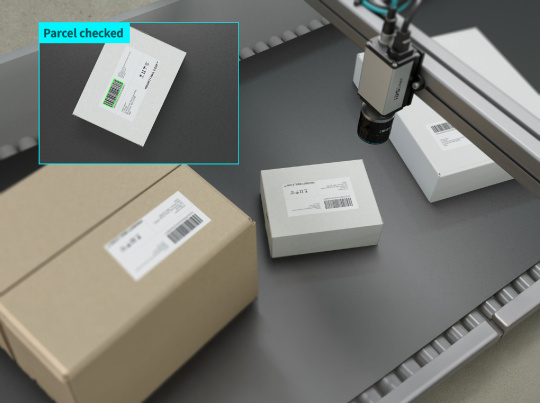
A sharp and high-contrast 2D image is required for barcode reading. It is crucial that even small codes are reliably captured during transport.
The uEye camera families offer different sensors, resolutions, designs, and interfaces. This allows the 2D industrial cameras to be adapted to the size of the field of view, the conveyor speed, the available installation space, and the environmental conditions.
For fast conveyor belts, global shutter sensors, short exposure times, and suitable lighting are particularly important. Monochrome cameras are often suitable for pure code reading. A color camera can be useful if colored labels, markings, or packaging features are also to be evaluated.
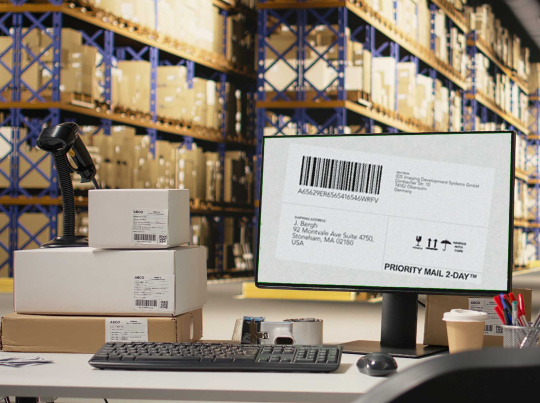
Track-and-trace
Typical application
Identify parcel and track them along the material flow
Recommended camera families
uEye 2D cameras in combination with Nion 3D ToF camera
Key features
Reliable code reading, position and volume acquisition, precise triggering, time stamps, and synchronized data
In track-and-trace, parcels are uniquely identified along the entire logistics process and assigned to the corresponding datasets. This enables seamless shipment tracking, including current status updates on the whereabouts of the parcels.
A uEye 2D camera captures barcodes or shipping labels and thus enables the unique identification of the parcels. For advanced requirements, it can be supplemented by a Nion 3D ToF camera, which provides additional information on position, height, and volume. This allows, for example, parcel overlaps to be detected and the occupancy rate of the conveyor belt to be determined. With the help of common trigger signals or time stamps, the 2D and 3D data can be uniquely assigned to the same parcel. The acquired information can subsequently be transmitted to a warehouse management system (WMS), a material flow computer, or directly to the system controller.
Overview Which camera family is suitable for which logistics field?
Application |
Recommended IDS camera family |
What matters? |
Why does this technology fit? |
|---|---|---|---|
Parcel measurement |
Measurement accuracy, measurement field, working distance, conveyor speed, and parcel surface |
Nion provides depth information for every pixel. This allows the length, width, height, and volume of parcels to be determined, for example in DWS systems or for automatic freight measurement. |
|
Parcel handling on conveyor belts |
Position, parcel height, occupancy rate, congestion detection, and real-time capability |
The 3D camera detects where a parcel is located, how high it is, and which area of the conveyor belt it occupies. This supports the monitoring and control of automated conveyor processes. |
|
Barcode reading |
Resolution, image sharpness, global shutter, triggering, conveyor speed, and lighting |
Sharp, high-contrast 2D images are required for 1D and 2D codes. The uEye families offer different sensors, resolutions, designs, and interfaces for various installation situations. |
|
OCR and label recognition |
Character size, print quality, changing or damaged labels, and type of processing |
IDS NXT is suitable for decentralized, AI-based recognition and classification. If the processing is to be performed on an industrial PC, various uEye 2D cameras are available for this purpose. |
|
Track-and-trace |
uEye 2D cameras in combination with Nion |
Identification rate, position, conveyor speed, triggering, timestamp, and synchronization |
The uEye camera captures codes, human-readable text, or labels. Nion complements position, height, and volume. This allows a parcel to be identified and tracked along the material flow. |
Depalletizing |
3D accuracy, point cloud density, working distance, pallet height, and box size |
Ensenso delivers detailed 3D point clouds with which robots can localize individual boxes and determine suitable gripping points. |
|
Robot-assisted parcel handling |
Gripping accuracy, object recognition, orientation, overlaps, and workspace |
The precise 3D data support robots in detecting, gripping, and safely moving parcels even in more complex scenes. |
|
Bin picking |
Point cloud quality, occlusions, object segmentation, and, if applicable, CAD matching |
For unordered or overlapping objects, accurate acquisition of the spatial geometry is crucial. Stereo vision cameras provide the appropriate data basis for this. |
Which camera is suitable for your logistics application?
The listed camera families represent recommended technologies for typical logistics applications. Depending on resolution, conveyor speed, working distance, lighting, environmental conditions, and existing evaluation architecture, other IDS camera models may also be suitable.
Our experts will support you in selecting a suitable solution for parcel measurement, barcode reading, track-and-trace, or robotics applications.
Why are IDS cameras particularly suitable for logistics applications?
- Broad technology portfolio:
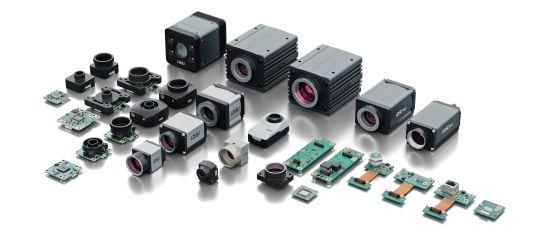
- With uEye 2D cameras, the Nion 3D ToF camera, IDS NXT AI cameras, and Ensenso stereo vision cameras, IDS offers suitable camera technologies for various logistics tasks.
- Reliable detection of moving objects:
- Depending on the model, IDS cameras offer global shutter sensors, high frame rates, and precise trigger functions for reliable parcel detection on conveyor belts.
- Flexible integration:
- Different designs, sensors, and interfaces facilitate integration into various logistics systems. With IDS peak, a uniform SDK (Software Development Kit) is also available for different camera models.
- Combinable 2D and 3D technologies:
- IDS camera families can be flexibly combined and adapted to different logistics tasks.
- Industrial quality and long-term availability:
- IDS cameras are designed for continuous use and offer long-term availability and investment protection.
- Made in Germany:
- IDS develops and produces in Obersulm and offers reliable image processing solutions with a three-year manufacturer warranty.
Conclusion:
For parcel handling, parcel measurement, barcode reading, and track-and-trace, there is no single suitable industrial camera. The decisive factor is what information the respective logistics application requires. IDS offers various, coordinated camera technologies for this purpose, which can be used individually or combined with each other.
As a compact guide:
- uEye 2D cameras for barcodes, human-readable text, and other 2D tasks
- Nion 3D ToF camera for position, height, dimensions, and volume
- IDS NXT AI cameras for AI-based label and object recognition
- Ensenso stereo vision cameras for precise 3D data in robotics and gripping tasks

Since 2011, Oliver Senghaas has served as Head of Marketing at IDS, driving the company’s global marketing strategy. He is responsible for corporate communications, brand management, digital campaigns, the content and functional development of the company websites and B2B web store, as well as the creation of technical documentation. His focus is on combining technology and creativity to position IDS clearly in the field of industrial image processing.
Your project
How can we support you in your project? Together we will find the right solution for you!
Vision Channel
Videos and live sessions about machine vision.
Newsletter
Stay up to date and subscribe to our newsletter.